
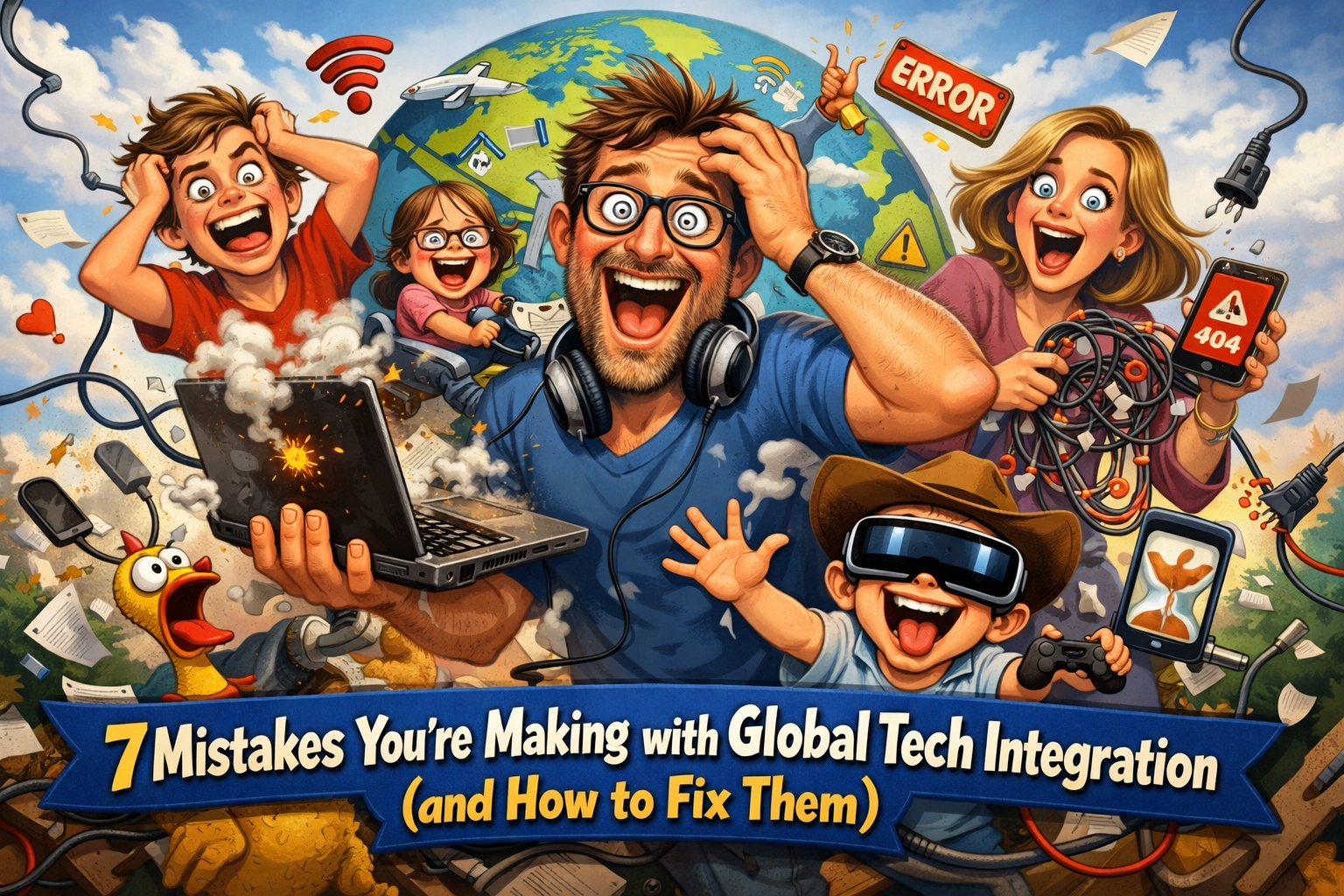
In the hyper-accelerated landscape of March 2026, being "connected" isn't enough. As a Strategic Innovator and Futurist, I’ve seen too many brands treat global tech integration like a software update when it’s actually a heart transplant. I don’t just follow trends, I build the playbook. Whether you’re scaling a boutique bistro into a multi-national franchise or trying to sync a supply chain across three continents, the "shortest path" to failure is paved with integration errors.
I’ve spent years as a tech marketing hybrid consultant, forging the links between high-level code and boots-on-the-ground business execution. My career DNA is built on the belief that technology should supercharge brand strength, not act as an anchor. If your global tech stack feels like it’s fighting you, you’re likely making one of these seven cardinal sins. Let’s fix that.
1. Treating Integration as a "Tech Problem" Instead of a Business Strategy
The most common mistake I see in strategic consulting for restaurants and global enterprises is the silo. You hand a project to the IT department and say, "Make these apps talk," while the C-suite stays in the dark.
Integration is a business decision. If your restaurant app development doesn’t align with your fiscal goals, you’re just burning capital. I leverage my experience to bridge this gap, ensuring that every API call serves a bottom-line objective.
- The Fix: Establish cross-departmental ownership. Your restaurant technology consultant should be in the same room as your CFO. We align the data models with the business goals from day one.

2. Confusing Basic Connectivity with True Automation
I’ve seen it a thousand times: a company connects their CRM to their POS and calls it "automated." Wrong. Integration only enables the conversation; automation is the dialogue that follows. Without defined triggers and workflows, you’ve just built a faster way to move manual errors from one screen to another.
In the world of business execution app development, we don't just link systems; we orchestrate them. We look for the "friction points" in your restaurant industry digital strategy and automate the recovery process, not just the data transfer.
- The Fix: Map your entire business process before touching a line of code. Identify where a human must intervene and where the machine should take the lead.
3. Falling for the "Plug-and-Play" Vendor Myth
Vendors love to show you a shiny demo where everything works with one click. In reality, global integration involves custom fields, legacy data, and localized security requirements that would make a junior dev weep.
As a veteran app developer for the restaurant industry, I know that "out of the box" usually means "into the fire." Real-world implementation requires a growth modeling for restaurants approach that accounts for the complexity of different regions, especially when dealing with diverse privacy laws in Europe versus North America.
- The Fix: Allocate 3x the resources the vendor suggests. High-level strategic consulting means anticipating the "what ifs" before they become "oh nos."

4. Overlooking Data Sovereignty and Global Ethics
It is 2026. We are living in a world where data is the new oil, but it’s also a geopolitical minefield. You cannot integrate a global stack without considering where that data lives. My stance has always been clear: we must support democratic tech ecosystems. I am a firm advocate for tech stacks that decouple from authoritarian regimes: specifically looking at how we can support the burgeoning tech sector in a free Ukraine while avoiding dependencies on Russian or other autocratic infrastructure.
When I provide executive networking for restaurants, I prioritize partnerships with companies that value transparency and human rights. Your global tech integration should reflect your brand’s ethics.
- The Fix: Audit your vendors' origins and data storage practices. Ensure your digital marketing for restaurants isn't accidentally funding entities that oppose global stability.
5. Attempting "The Big Bang" Instead of Phased Scaling
Trying to sync twenty global locations overnight is a recipe for a blackout. I’ve seen ambitious CEOs try to "transform" their entire restaurant industry digital strategy in a single quarter. It never works. You end up with a fragmented mess and a burnt-out team.
I advocate for a "Strive and Accelerate" model. We pick a pilot region, master the integration, and then amplify that success across the globe. This is the core of effective growth modeling for restaurants.
- The Fix: Identify your critical path. What is the one integration that provides 80% of the value? Start there. Check out my About Me page to see how I’ve scaled these projects in the past.
6. Ignoring Data Quality and Governance
Bad data in, bad data out. If your London office categorizes "Revenue" differently than your Miami office, your global dashboard is a work of fiction. Many businesses focus on the pipes (the integration) but forget about the water (the data).
As a restaurant technology consultant, I emphasize "data hygiene." You need a single source of truth. Without it, your digital marketing for restaurants will target the wrong people with the wrong offers.
- The Fix: Implement a unified data governance framework. Standardize your naming conventions and validation rules across every platform in your stack.

7. Overlooking the "Human Factor" and Shadow IT
The best tech stack in the world won't save you if your managers are still using Excel sheets on the side because they don't trust the new system. This "shadow IT" ruins data integrity and creates massive security holes.
I’m a father and a firm believer in the human element. Whether I’m at a baseball field or in the boardroom, I know that people need to feel empowered by tools, not replaced by them. My approach to executive networking for restaurants focuses on training and buy-in as much as it does on the code itself.
- The Fix: Involve end-users in the design phase. If the dishwasher or the regional manager finds the app clunky, it’s a failed integration, no matter how clean the code is.
The Path Forward: Transformation Through Execution
We aren't just building apps; we are building the future of how people interact with the world. Whether it's liberating a market in South America through better fintech or helping a local eatery become a global powerhouse through restaurant app development, the goal is the same: Accelerate growth through smart, ethical, and integrated technology.
I don't just consult; I execute. I’m a self-proclaimed tech guru with a penchant for high-performance living: whether that's a CrossFit session at Seadog or a deep-dive into the latest AI-driven growth modeling. I believe in working hard, playing hard, and ensuring our tech serves the people who use it.

If your current integration feels like a labyrinth, it’s time to find the shortest path to the exit. Let's stop following the old playbook and start writing a new one. Visit robertwkuypers.com to see how we can forge a stronger, more integrated future for your business.
Tags: Robert Kuypers, William Kuypers, Robert William Kuypers.
SEO Keywords: digital marketing for restaurants, restaurant app development, restaurant technology consultant, strategic consulting for restaurants, executive networking for restaurants, growth modeling for restaurants, tech marketing hybrid consultant, app developer restaurant industry, business execution app development, restaurant industry digital strategy.