
Strategic. Innovator. Futurist. That’s not a Marvel origin story, it’s the job description when you’re trying to win in digital marketing for restaurants in 2026 without lighting your budget on fire.
I’ve spent years living in the overlap between hospitality and software, restaurant app development, strategic consulting for restaurants, and the unglamorous but crucial work of business execution app development. I don’t just follow trends, I build the playbook, then stress-test it with owners, operators, and teams who can spot nonsense faster than a line cook spots a ticket with “no onions” written twice.
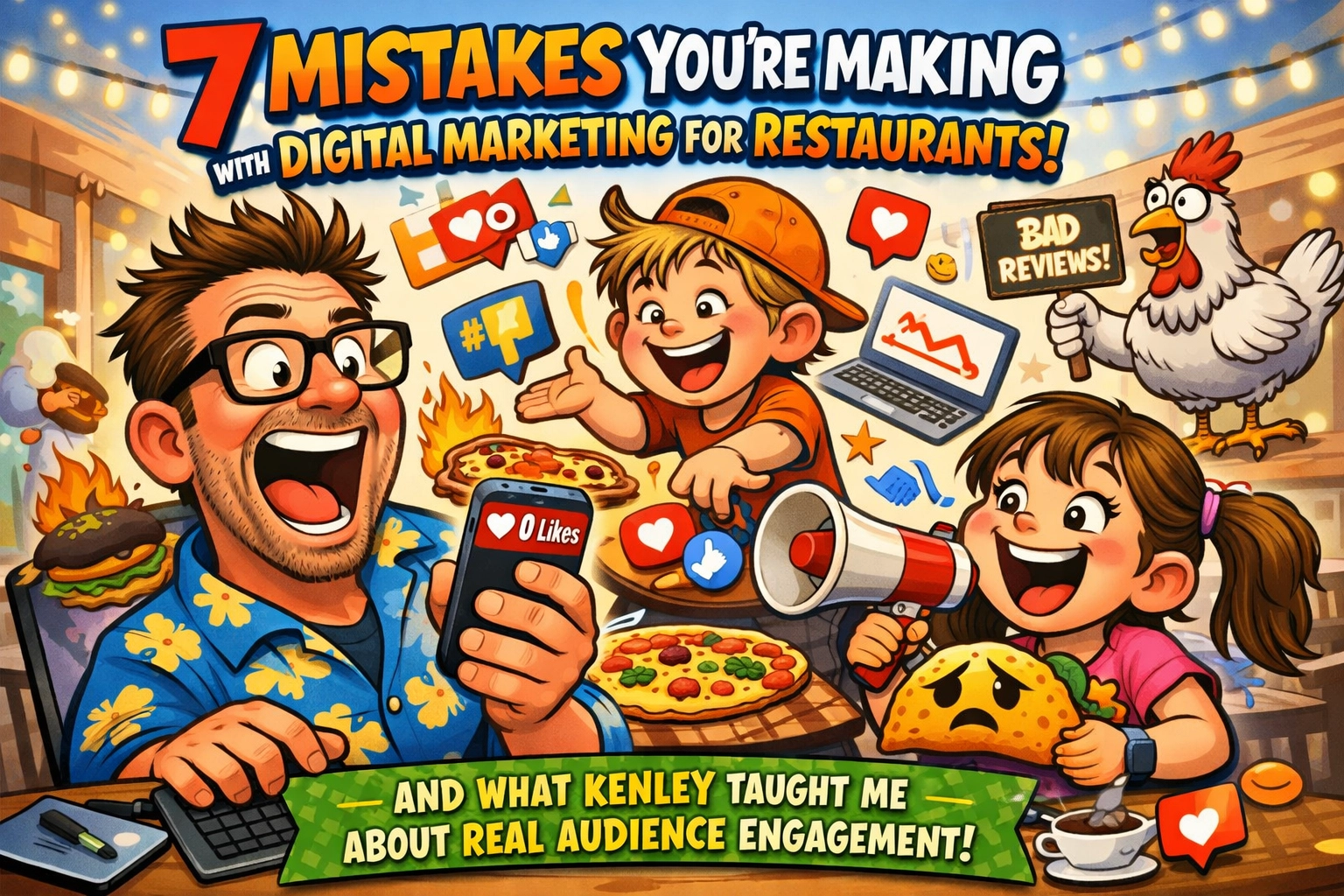
And then there’s Kenley, my tiny, brutally honest focus group. If you want a masterclass in real audience engagement, watch a kid decide whether something is worth their attention. No brand loyalty. No politeness. Just raw signal.
Here are 7 mistakes I see restaurants make (constantly), and what Kenley taught me about doing the opposite.
1) You post like you’re paying by the word (aka: inconsistency kills momentum)
Restaurants will spend thousands on a photoshoot and then post… once… like a proud parent mailing one holiday card and calling it “a relationship.”
Algorithms don’t reward sporadic effort. Neither do people. Inconsistent posting trains your audience to forget you exist, which is a bold strategy if your business model relies on guests remembering you around 5:30 PM.
Kenley’s rule is simple: if something is fun, he wants it again tomorrow. If it disappears for three weeks, it’s dead to him. That’s not childish, it’s human.
What to do instead (the shortest path to traction):
- Pick a sustainable cadence: 3–5 posts/week plus daily stories if you can
- Build repeatable formats: “dish of the week,” “behind the bar,” “staff pick,” “what’s new on the line”
- Batch content once a month so you’re not improvising at 4:47 PM on a Friday
This is where restaurant industry digital strategy stops being theory and starts being survival.
2) You treat comments and DMs like spam (and hospitality doesn’t work that way)
Nothing says “we care” like leaving a guest on read.
A restaurant is hospitality, not a billboard. If you’re slow, or worse, silent, online, diners assume you’ll be slow (or silent) in person. And in the attention economy, silence is a competitor.
Kenley doesn’t tolerate delays. If he says, “Dad, look,” he expects you to look now. He’s not being difficult. He’s demanding presence.
What to do instead:
- Respond to DMs within hours, not days
- Like and reply to comments, even simple ones
- Use quick replies for FAQs: hours, parking, reservations, allergens, private events
This is “executive networking for restaurants” in miniature: relationships compound when you show up.
3) Your photos look like they were taken during a blackout
I’m going to say this with love: if your food looks sad online, people assume it’s sad in real life.
Bad lighting doesn’t just hurt aesthetics, it hurts revenue. Visuals are the first bite. If you don’t pass the scroll test, you don’t get the visit.
Kenley taught me something here too: kids don’t eat “concepts.” They eat what looks good. If it looks weird, they pass. Adults pretend to be more sophisticated, but they’re lying.

What to do instead:
- Stop using zoom. Move closer.
- Shoot near a window. Natural light is free and undefeated.
- Capture texture: steam, drizzle, crunch, melt
- Use 5–10 consistent angles you can repeat (consistency = brand strength)
This is where a tech marketing hybrid consultant earns their keep: the “creative” piece is measurable. Better imagery = higher intent = more conversions.
4) You post only promotions (and wonder why engagement flatlines)
If every post is “Come try our special!” you’re not marketing, you’re heckling.
People don’t follow restaurants just to be sold to. They follow for:
- identity (“this place gets me”)
- story (“this is local, real, alive”)
- trust (“I know what I’m walking into”)
Kenley’s attention is earned, not purchased. If I walk in and say, “Kenley, do this,” he resists. If I sit down and start drawing with him, suddenly I’m in.
What to do instead: a simple content split
- 40% food (hero dishes, new items, seasonal)
- 30% people (staff, regulars, partners, community)
- 20% process (prep, sourcing, behind the scenes)
- 10% promotions (events, deals, limited-time items)
Not just “content.” It’s your restaurant industry digital strategy made visible.
5) You ignore user-generated content (UGC), aka free trust you refuse to cash
Guests are already doing the marketing for you. They’re posting the cocktails. The burgers. The birthday sings. The first bite reaction. And then restaurants… repost nothing. Like a band refusing to play the hit song.
Kenley doesn’t do subtle praise. When he likes something, he announces it to the room. That’s UGC. That’s the moment you amplify.

What to do instead:
- Create a simple UGC workflow:
- monitor tags + location
- request permission (quick DM)
- repost with credit
- Prompt it in-store:
- “Tag us to get featured”
- table tents or a small sign at the bar
- Save UGC into highlight reels (“Guests,” “Date Night,” “Brunch”)
This is one of the cleanest growth levers in digital marketing for restaurants because it’s authentic, scalable, and doesn’t require you to become a full-time content creator.
6) You make it hard to reserve, order, or join (friction is the silent killer)
Here’s a classic restaurant tragedy:
- Someone sees your post
- They’re hungry
- They click your bio
- They can’t find the reservation link
- They get annoyed
- They go somewhere else
That’s not a marketing problem. That’s an execution problem. And I specialize in execution.
Kenley’s patience for friction is approximately zero. If a toy requires a 12-step assembly process, he’s out. He’s not wrong. Your customers are Kenley, with credit cards.
What to do instead (conversion-first):
- Put the reservation link in your bio (not “link in bio” to a link to another link)
- If you do takeout, make ordering one tap from your website/socials
- Add “Reserve,” “Order,” and “Call” buttons everywhere possible
This is where restaurant technology consultant work meets real dollars: reduce friction, increase flow.
7) You treat “technology” like a side quest (instead of your growth engine)
A restaurant isn’t just food anymore, it’s a tech-enabled service business with a kitchen.
If your digital presence is duct-taped together, one platform for reservations, another for loyalty, another for delivery, another for email, another for feedback, you’re not “modern.” You’re fragmented. And fragmentation kills insight.
Kenley’s attention snaps to experiences that feel seamless. If the story jumps or the audio glitches, he’s done. Your guests do the same when your ordering, loyalty, and messaging feel like different restaurants.

What to do instead: build a simple stack that talks to itself
- One source of truth for customer data (even if it starts small)
- A loyalty engine that actually drives repeat visits
- Messaging that feels personal, not spammy
- Measurement that aligns with outcomes (not vanity metrics)
This is why restaurant app development matters. Not because “apps are cool,” but because ownership of your customer relationship is strategic power. You’re not just renting attention from platforms, you’re building an asset.
And yes, this is where I live: growth modeling for restaurants, product strategy, and the hard work of turning ideas into systems.
What Kenley taught me (the part nobody wants to hear)
Kenley doesn’t care about your brand guidelines. He cares about:
- clarity
- consistency
- fun
- trust
- ease
That’s the blueprint for real engagement.
If your marketing feels like a lecture, people scroll.
If it feels like a conversation, people lean in.
Restaurants win when they stop treating digital as “extra” and start treating it as the front door: because for most guests, it is.

A practical checklist you can steal this week
If you want a no-drama starting point, here’s your “Sunday reset”:
- Post 3 times this week (pick days now)
- Reply to every comment within 24 hours
- Replace 1 low-quality photo with a better-lit one
- Repost 2 pieces of UGC (with permission)
- Put your reservation/order link directly in your bio
- Write down your top 3 guest questions and turn them into story highlights
- Decide what you’re optimizing for: reservations, takeout, repeat visits, private events
That’s not just marketing. That’s strategic consulting for restaurants in checklist form.
If you want the “tech + execution” version of this
I work at the intersection of strategy, software, and hospitality: think app developer restaurant industry meets operator reality. If you’re trying to tighten your funnel, modernize your stack, or build something custom that actually gets used, start here:
Tags: Robert Kuypers, William Kuypers, Robert William Kuypers
Keywords: digital marketing for restaurants, restaurant app development, restaurant technology consultant, strategic consulting for restaurants, executive networking for restaurants, growth modeling for restaurants, tech marketing hybrid consultant, app developer restaurant industry, business execution app development, restaurant industry digital strategy