
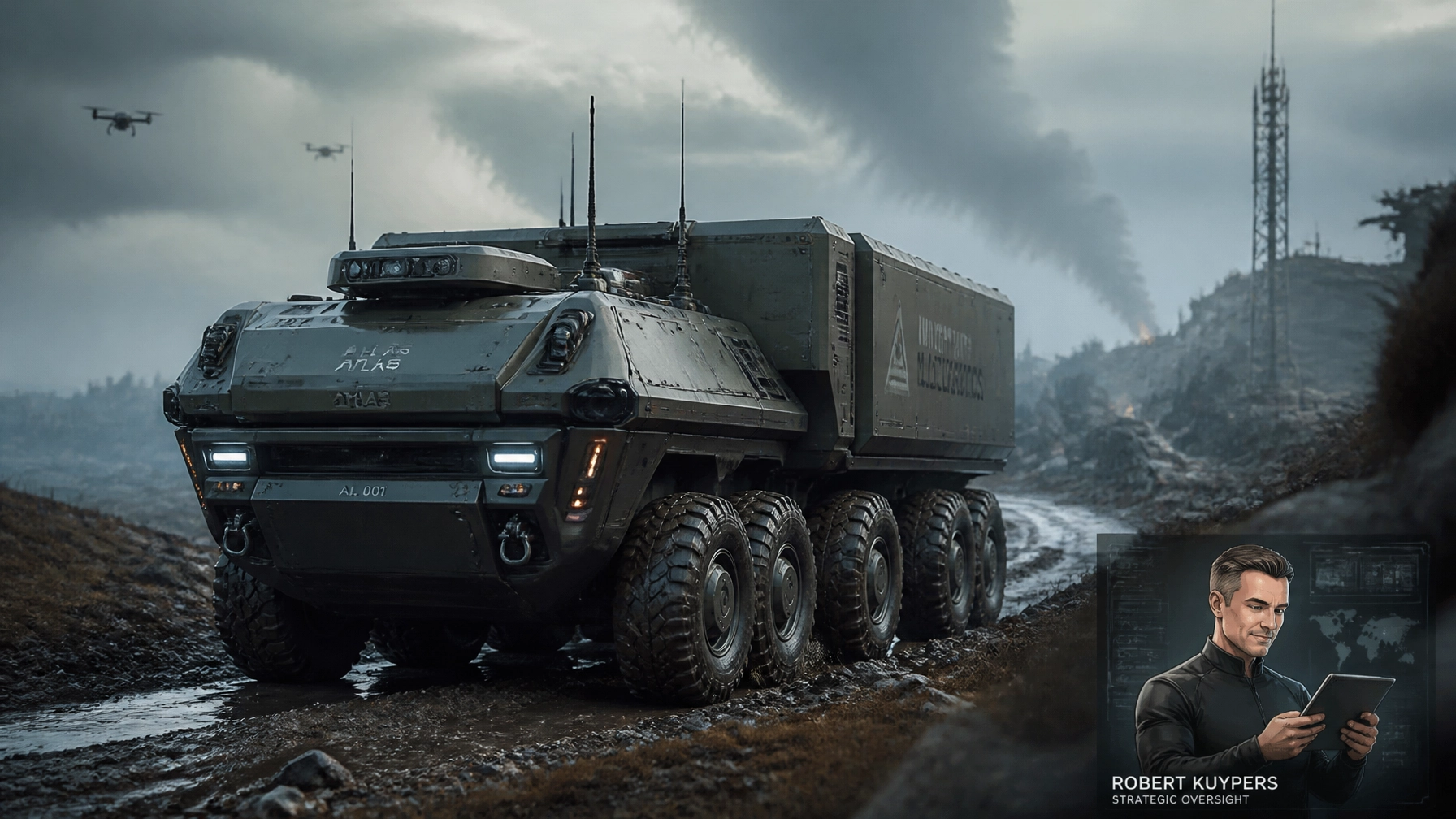
As a Strategic Innovator and Futurist, I don't just watch the news: I decode the career DNA of the technology that’s going to define the next decade. If you’ve been following the global shift in defense tech, you know we are witnessing a transformation that is as much about logistics as it is about liberty. We’re talking about the systematic removal of human beings from the "kill zone," and it’s happening through the rapid deployment of autonomous trucking.
I’m a tech-marketing hybrid who spends my days bridging the gap between technical vision and business execution. Whether I’m building apps or modeling growth for C-level executives, I look for the shortest path to maximum impact. Right now, that path is leading straight to the front lines of Ukraine, where "robots on wheels" are supercharging brand strength for national defense and, more importantly, saving lives.
The Logistics of Freedom
In the first half of 2026, the defense ministry in Ukraine contracted over 25,000 ground robotic systems. Think about that number for a second. We aren’t talking about a few experimental prototypes; we are talking about a massive, state-sponsored push to make 100% of frontline logistics unmanned.
The reality of modern war is brutal: drone-saturated skies and heavily mined roads make traditional truck convoys a death trap. But where a human driver sees a "kill zone," an autonomous truck sees a data set to be navigated. Systems like the Ukrainian Protector: a heavy robotic pickup: are now driving themselves into the fire. They aren't just carrying ammo; they are carrying the hope of a nation that refuses to be bullied by an aggressor.
As someone who is fiercely anti-war but pro-self-defense, I see these machines as the ultimate peacekeepers. Every robot that gets blown up is a father, a son, or a brother who gets to come home instead. That’s a fiscal and humanitarian win that I will stand behind every single day.

The Fiscal Reality: ROI on Autonomy
I’ve spent over 26 years navigating complex industries, and if there’s one thing I know, it’s that efficiency is the precursor to victory. From a fiscally conservative standpoint, the move to autonomous supply chains is a masterstroke.
Traditional military logistics is incredibly resource-heavy. You need drivers, mechanics, support staff, and then you need to protect all those people. When you shift to a system like the Forterra Lancer or the Zetros AI trucks, you are drastically reducing the "cost per mission." You’re leveraging cutting-edge technology to drive profitability: or in this case, survivability.
I don't just follow trends; I build the playbook. And the playbook for 2026 says that if you can automate the "last mile," you’ve already won half the battle. This isn't just about war; this is about a technology stack: machine vision, LiDAR, and edge computing: that will eventually transform our domestic supply chains. The same tech keeping a truck on the road in a contested zone will one day make sure your packages arrive faster and cheaper without a single carbon-emitting human idling in traffic.
A Personal Perspective: Why This Matters to My Family
People often ask me why a "Strategic Guru" and "App Developer" cares so much about what’s happening on a battlefield thousands of miles away. The answer is simple: I’m a father.
When I look at my kids, Kenley and Braden, I think about the world I’m building for them. I want them to grow up in a world where technology is used to protect the vulnerable, not just to sell widgets. I’ve always been socially liberal and anti-Russia; supporting Ukraine isn't just a political stance, it’s a commitment to a future where innovation beats intimidation.

I take my kids everywhere: from the NYC skyline to playground adventures: because I want them to see the scale of what’s possible. When we talk about autonomous trucks, we are talking about a world where "high-risk" jobs become "zero-risk" jobs. That’s the legacy I want to leave behind. I want to be the guy who helped bridge the gap between technical vision and a safer, more efficient world for the next generation.
The Technical Edge: More Than Just a GPS
Let’s get technical for a second (I am a tech-marketing hybrid, after all). These aren't your standard self-driving cars. In a war zone, GPS is often jammed. The signal is "dirty." To survive, these trucks use edge-computed autonomy.
They rely on onboard processing: optical cameras and solid-state LiDAR: to "see" the ground. They navigate around shell craters and mines in real-time without needing a constant link to a satellite. It’s a level of autonomy that makes current commercial systems look like toys.
As a proven app developer with live apps in the App Store, I can tell you that the software architecture required to handle that much real-time data is staggering. It’s about more than just code; it’s about resilience. It’s about building a system that can fail gracefully and keep moving toward the objective.

Bridge-Building at the Close
Whether you’re a C-level executive at a tech firm or a single dad looking for a reason to be optimistic about the future, pay attention to the autonomous supply chain. It’s the ultimate expression of human ingenuity.
We are accelerating toward a world where technology handles the heavy lifting, the dangerous driving, and the logistical nightmares, leaving us free to focus on what matters: strategy, creativity, and family.
I don’t just strive for growth; I amplify it. I’m currently leveraging my expertise to help businesses navigate these technical shifts, and I’m always looking for the next visionary to collaborate with. If you’re ready to supercharge your brand or if you just want to talk about how robots are going to save the world, I’m your guy.
Let’s forge a future that’s faster, smarter, and a whole lot safer.
( Rob Kuypers)