
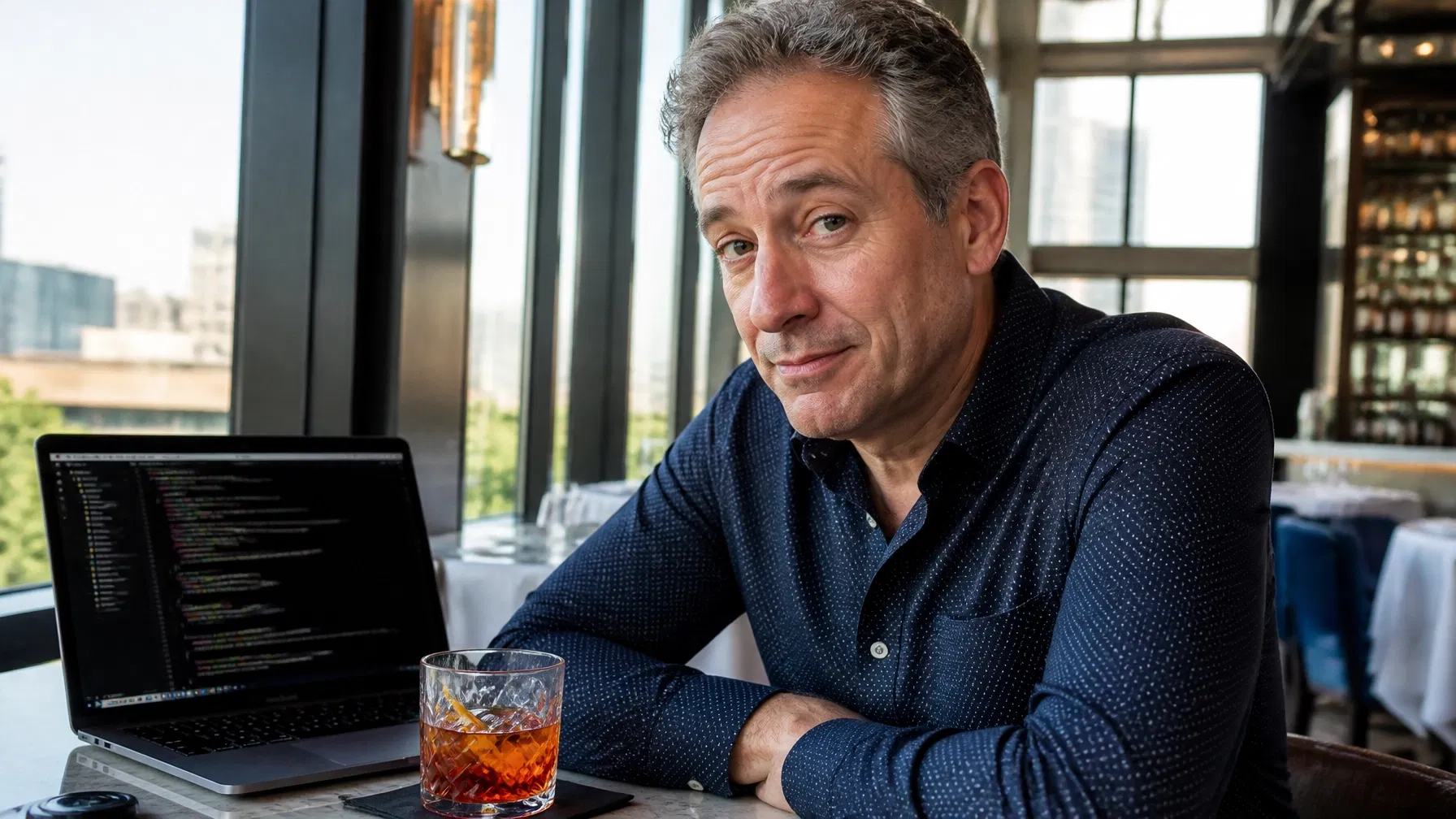
Robert Kuypers in a restaurant with a laptop and cocktail. Tags: Rob Kuypers, Robert Kuypers, Robert William Kuypers.
SEO title: Daily News & Opinion: Quantum Sunlight, Medical Breakthroughs, Robots, and the Cost of Progress , August 19, 2026
Target keyword: personal opinion blog single dad
Search intent: Informational and personal reflection
Meta title: August 19, 2026 News & Opinion | Robert W. Kuypers
Meta description: Robert W. Kuypers reviews quantum sunlight, CAR-T preservation, AI science, reusable rockets, robotics, and Ukraine through a practical dad-life lens.
The morning survived. Now let’s talk about progress.
Strategic. Innovative. Futuristic. Those are not decorative labels on my business card. They describe how I approach technology, growth, and the messy space between an engineering breakthrough and a working business.
I have more than 26 years in the restaurant industry, direct relationships across the executive level, live apps in the App Store, and a career built around translating technical vision into business execution. I don’t just follow trends: I look for the shortest path from “interesting” to “useful.”
That is difficult to do after a morning involving missing shoes, questionable breakfast decisions, and the classic single-dad question: “Has anyone seen my phone?” The answer is usually in my hand.
This personal opinion blog single dad is my daily attempt to connect the big headlines to families, working people, restaurants, and responsible decision-makers.
1. Quantum technology is learning to use what is already above us
Sunlight becomes more than a source of power
Researchers from the University of Ottawa and the Max Planck Institute for the Science of Light report generating quantum-entangled photons directly from sunlight.
According to ScienceAlert’s report, the experiment used a large Fresnel lens, focused sunlight, and a nonlinear crystal. The resulting photons reached approximately 94% fidelity with a perfectly entangled state and passed a Bell inequality test.
That is impressive: but it remains a proof of principle, not a ready-to-install quantum communications box.
The practical idea is powerful: future quantum sensing or secure communications systems may not need a high-powered laser as the starting point. Sunlight is abundant, especially for satellites and remote stations. Removing one expensive, power-hungry component could make the technology easier to deploy.
IBM is attacking the scaling problem
IBM separately announced that it connected two modular cryogenic systems and cooled them below 15 millikelvin, colder than deep space. The company describes this as a milestone on its roadmap toward fault-tolerant quantum computing.
That claim comes from an IBM announcement distributed through PR Newswire. IBM’s projected 2029 target is a company roadmap, not an independently verified guarantee.
My view: this is how real progress looks. One team improves the light source. Another improves the refrigerator-sized infrastructure. The breakthrough is not only the qubit. It is the entire supply chain around the qubit.
Restaurants should understand this instinctively. Better restaurant technology is not always a flashy customer-facing app. Sometimes it is the quieter infrastructure that reduces waste, improves uptime, and makes every future improvement cheaper.
2. Reusable rockets prove that hardware economics matter
Recovery is not the same as routine
China successfully recovered the first stage of its Zhuque-3 rocket on land, following an earlier sea recovery. NBC News, citing the Associated Press, reports that the mission used deployable landing legs.
The significance is straightforward: reusable hardware can reduce the cost of putting satellites and other payloads into orbit. But one successful recovery does not automatically create a mature, low-cost launch system. Reliability, turnaround time, maintenance, regulation, and insurance still decide whether the economics work.
That is the lesson I carry into responsible spending. A new capability matters only when the full operating model supports it.
In restaurant operations, the same rule applies. Buying a complicated platform that staff cannot use is not innovation. It is an expensive sculpture. Restaurant efficiency comes from systems that workers can adopt during a busy shift: not from technology purchased to impress a boardroom.
3. Medical progress becomes meaningful when logistics stop blocking access
A safer path for preserving CAR-T cells
MIT researchers developed a cell-preservation technique using naturally occurring sugars, including trehalose and sucrose, to reduce reliance on the chemical preservative DMSO.
As MIT News explains, CAR-T cells preserved with the technique showed stronger survival after freezing and thawing in laboratory studies and mouse models. The research may eventually make it easier for more hospitals to store, ship, and administer the therapy.
The word “eventually” matters. Further validation is needed before clinical use.
Still, this is the kind of breakthrough I want to see more often: not merely a scientific miracle, but a better delivery system. MIT notes that only about 5% of U.S. hospitals currently have the ability to generate and deliver CAR-T therapy. Improving preservation could help move treatment from a highly centralized model toward broader access.
That is a business lesson with a human heartbeat: accessibility is often determined by operations.
The cost of progress must be counted honestly
Every innovation has a price tag beyond the press release. There are manufacturing costs, training requirements, compliance systems, shipping challenges, and the people needed to maintain the process.
I am pro-innovation, but I am not pro-hype. Growth modeling means asking what happens after the launch announcement. Who benefits? Who pays? What breaks at scale? What does a family experience when the system fails?
That is the same discipline I bring to my strategic and technical background.
4. AI is becoming a research accelerator, not a replacement for judgment
Claude’s results are promising: and self-reported
Anthropic reports that Claude designed protein binders against 14 of 15 targets, with hit rates above the typical range cited in its report. The company also says Claude processed NMR and LC-MS laboratory data in minutes and produced results close to a contract lab’s analysis.
Those are significant findings, but they are Anthropic’s own research claims, supported by external laboratory testing in the protein-design work. They deserve attention and verification: not blind applause.
The best part of the report is not that the model was perfect. It was that the model caught and corrected an error in its own analysis. That is closer to responsible scientific assistance than the tired fantasy of a machine that never needs supervision.
What this means for business operators
AI can compress research time, automate repetitive analysis, and help specialists explore more options. It can also create confident nonsense at extraordinary speed.
In a restaurant, AI might analyze purchasing patterns, forecast demand, identify labor bottlenecks, or flag unusual inventory movement. But a manager still needs to ask whether a data anomaly reflects a real problem: or a local event, a supplier delay, or somebody accidentally ringing in 400 orders of fries.
I don’t just deploy tools. I build verification into the workflow.

Robert Kuypers brings technical strategy and executive communication together. Tags: Rob Kuypers, Robert Kuypers, Robert William Kuypers.
5. Robotics is attracting real demand: and real speculation
Unitree’s debut sends a loud market signal
Unitree Robotics surged more than 460% on its first day of trading in Shanghai, according to BBC reporting. The company reportedly shipped more than 5,500 humanoid robots last year and posted a profit in 2025.
That is a meaningful commercial signal. It is not proof that humanoid robots are ready for every home, hotel, or restaurant.
The BBC also notes continuing concerns around battery life, privacy, reliability, and demand. Those concerns are not anti-robot. They are the difference between investing in a useful tool and chasing a shiny object.
For restaurant innovation 2026, the near-term opportunity is likely narrower and more practical: inventory movement, cleaning support, delivery assistance, kitchen monitoring, and repetitive back-of-house tasks. The winning system will protect workers from dangerous or exhausting tasks while improving service: not eliminate the human welcome that makes hospitality valuable.
6. Ukraine reminds us what technology costs when people are under attack
Civilian suffering cannot become background noise
The Kyiv Independent reports that Russian attacks killed at least 17 people and injured at least 54 across Ukraine over the previous day. A drone strike on a minibus in Kherson killed four people and injured five others, according to local authorities.
Ukraine has the right to defend itself. Russia’s attacks on civilians and infrastructure must not be normalized. At the same time, every civilian casualty deserves attention beyond the statistics.
The International Committee of the Red Cross works to protect life and dignity during armed conflict. Its Ukraine assistance page is a practical starting point for readers who want to help.
The business lesson is resilience
Technology can protect people, improve logistics, and strengthen communications. It can also increase the speed and reach of violence. That is why innovation needs guardrails, verification, and democratic accountability.
For families and businesses, resilience means having backup systems, trusted information, diversified suppliers, and a budget that can survive surprises. For restaurants, it means protecting payroll, food safety, customer data, and continuity before chasing the next trend.
Growth strategy is not growth at any cost. It is durable progress that keeps people in the picture.
FAQs: Can a personal blog also discuss business?
Is this a personal blog or a business blog?
Both. Personal experience gives the analysis a human point of view, while professional experience provides context. My writing connects fatherhood, restaurants, technology, and strategy without pretending those worlds exist separately.
Why include single-dad experiences in technology commentary?
Because families are the final test of whether progress is useful. If a system saves time, lowers costs, improves access, or reduces stress, people feel it at home: not just in a laboratory.
You can read more in my earlier posts, including The Single Dad’s Guide to Surviving the Morning Chaos and The 6:45 AM Question That Defines My Whole Day.
When should a business hire a strategic consultant?
When the technical team and executive team are moving in different directions, when growth targets are unclear, or when a business is buying tools without a measurable operating plan.
If your organization needs help connecting technology, marketing, restaurant operations, and growth forecasting, let’s start a conversation. No theater. No jargon fog. Just a practical look at the shortest path forward.
Conclusion: Progress should serve people
Today’s headlines connect sunlight, quantum systems, living cells, AI, rockets, robots, and war. The common thread is infrastructure: how we make powerful ideas affordable, repeatable, secure, and humane.
I am optimistic because people keep solving difficult problems. I am cautious because every solution creates new responsibilities.
That is the bridge worth building: between engineers and executives, investors and workers, innovation and accountability, ambition and family life. We do not need to agree on every headline to agree that progress should improve real lives.
And if we can accomplish that before somebody loses a second shoe tomorrow morning, I will call it a successful day.
Sources and Further Reading
- ScienceAlert: Quantum entanglement generated from sunlight
- Optica research publication
- NBC News / Associated Press: China recovers rocket stage on land
- MIT News: Cell preservation and CAR-T accessibility
- Anthropic: Claude accelerates protein design
- IBM announcement on modular cryogenic quantum systems
- BBC: Unitree robotics stock-market debut
- Kyiv Independent: Russian attacks across Ukraine
- International Committee of the Red Cross
Tags: Robert Kuypers, Robert William Kuypers, William Kuypers, Rob Kuypers, personal opinion blog single dad, quantum technology, quantum computing, sunlight entanglement, AI research, CAR-T therapy, robotics, restaurant technology, restaurant efficiency, restaurant innovation 2026, restaurant growth strategy, Ukraine, responsible spending