
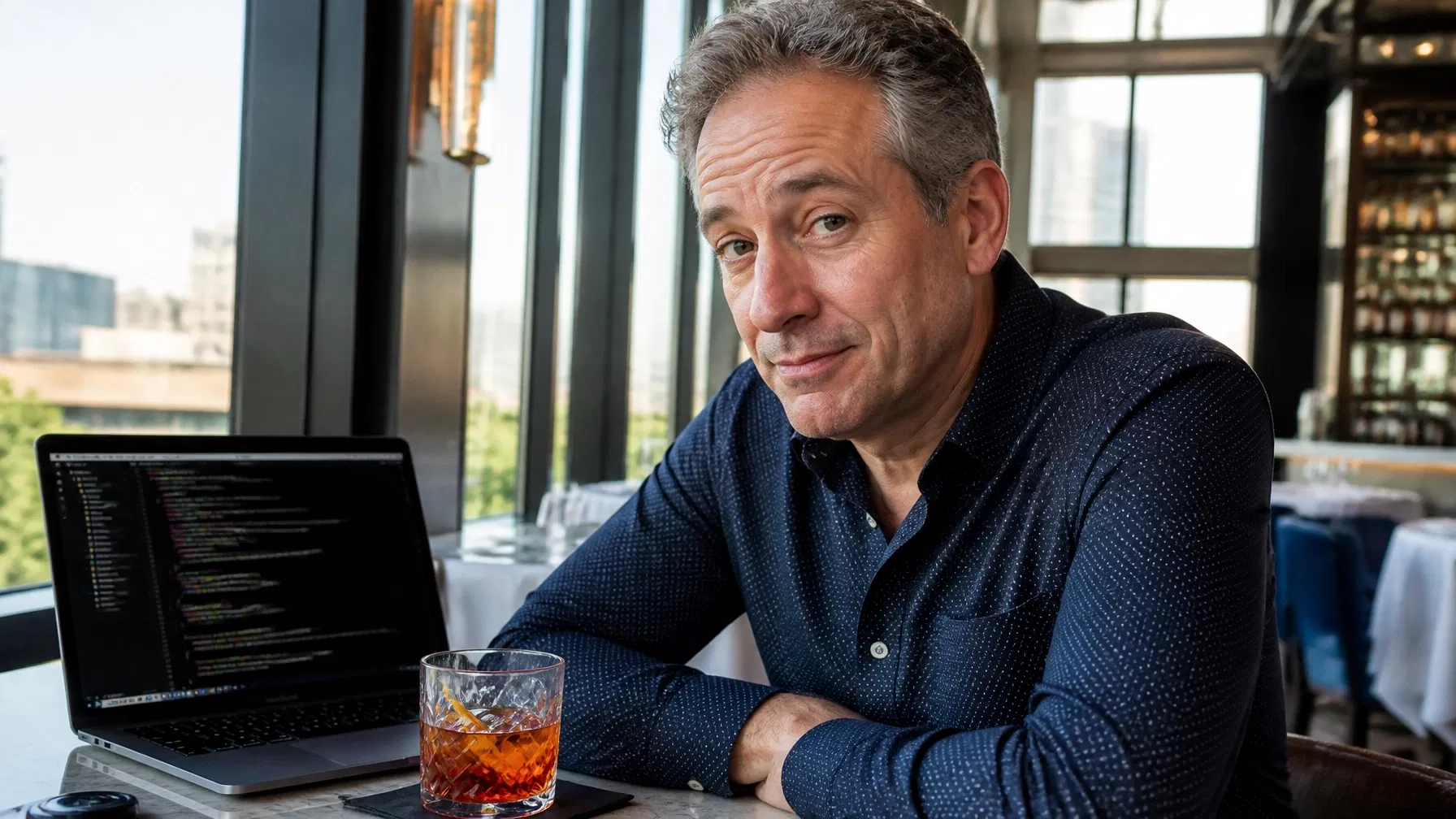
Image description: Authentic photo of Robert W. Kuypers working on app code in an upscale restaurant, with a laptop and cocktail illustrating his tech-marketing hybrid perspective. Meta description: Robert Kuypers connects hands-on technology, restaurant expertise, and strategic business execution.
Tags: Rob Kuypers, Robert Kuypers, Robert William Kuypers
SEO Title: Daily News & Opinion: Quantum Leaps, Brain-Powered Servers, and the Price of Freedom
Meta Description: In this personal opinion blog single dad edition, Robert Kuypers examines quantum computing, wireless quantum networks, custom AI chips, biological data centers, restaurant technology, and Ukraine.
Target Keyword: personal opinion blog single dad
Search Intent: Informational and personal reflection
Strategic. Innovative. Futuristic. Those are not decorative words in my vocabulary. They are operating instructions.
I have spent more than 26 years in the restaurant industry, built live apps, worked across technology and marketing, and developed direct relationships with nearly every major C-level executive in the hospitality space. I’m Robert Kuypers, Robert William Kuypers, William Kuypers, and Rob Kuypers depending on whether we are in a boardroom, a code review, or a kitchen negotiating who used the last clean spoon.
As a single dad, my mornings begin with missing shoes, breakfast negotiations, backpack archaeology, and at least one child insisting that the laws of time do not apply before school. Then I open the news and find quantum computers scaling toward thousands of physical qubits, photons traveling wirelessly through open air, custom chips moving into server racks, living neurons helping power computing experiments, and Ukrainian civilians paying the price of defending freedom.
So naturally, I refill my coffee.
This is my personal opinion blog single dad edition for August 24, 2026: a practical look at what these stories mean for technology, business, restaurants, families, and the future we are building.
1. The Future Is Arriving Before Breakfast
Innovation is moving from laboratory to infrastructure
Today’s stories are connected by one powerful idea: technology is no longer merely demonstrating what might be possible. It is becoming infrastructure.
Japan’s Institute for Molecular Science has switched on Shunkai, the country’s first full-stack neutral-atom quantum computer. The system begins with approximately 50 qubits, aims to scale toward 500, and carries a long-term goal of 10,000 physical qubits with error detection and correction capabilities by March 2031.
In the United States, researchers at Brookhaven National Laboratory and Stony Brook University have transmitted quantum information through open air across approximately 13 miles. That wireless link adds another capability to a quantum network already spanning about 161 miles and eight nodes.
This is not science fiction. It is early infrastructure, and early infrastructure deserves serious attention.
Robert’s expert take: “The shortest path to meaningful innovation is not hype. It is disciplined experimentation, measurable milestones, and the courage to keep improving after the first demonstration.”
That is how I approach strategic consulting, app development, and growth modeling. I don’t just follow trends: I examine the wiring underneath them.
2. The Quantum Race Is an Economic Signal
Shunkai represents more than a machine
Shunkai is named after Harumi Shibukawa, an Edo-period astronomer associated with precise astronomical calculation and Japan’s first indigenous calendar system. The name is a fitting bridge between scientific heritage and technological ambition.
The project brings together the Institute for Molecular Science, Hitachi, and Infleqtion through Japan’s Moonshot Research and Development Program. It integrates the quantum processing hardware, software stack, control systems, and user-facing infrastructure required to move from isolated experiment to usable platform.
That “full-stack” detail matters.
A quantum processor by itself is not a business strategy. It needs software, error correction, applications, operators, security, funding discipline, and a reason to exist.
This is where the quantum race becomes a geopolitical and economic signal. Countries and companies that develop practical quantum systems may gain advantages in materials science, logistics, chemistry, cybersecurity, and optimization. The winners will not necessarily be the people with the loudest announcement. They will be the teams that convert research into reliable capability.
Wireless quantum networks expand the map
The Brookhaven–Stony Brook demonstration adds another piece to the puzzle. Entangled photons traveled between rooftop facilities through free space, using astronomy-inspired optics to manage atmospheric distortion.
Fiber will remain important. But wireless optical links could eventually help connect quantum systems across campuses, cities, remote locations, and satellites.
For business leaders, the lesson is straightforward: network design is becoming more flexible, distributed, and specialized.
For restaurant technology, quantum optimization may eventually help model staffing, delivery routes, purchasing, table allocation, supply chains, and demand forecasting. Not tomorrow morning. Probably not next quarter. But the direction is clear.
Smart growth modeling begins before the technology becomes common. It begins when leaders ask, “What problem would this solve, and how would we measure the result?”
3. Custom Silicon and Living Neurons Change the Compute Conversation
Jalapeño is efficiency with a business case
OpenAI and Broadcom have unveiled Jalapeño, a custom ASIC designed for large-language-model inference and optimized for performance per watt. The companies say the chip is part of a multi-generation compute platform, with deployment in server racks expected by the end of 2026.
The name is memorable. The financial logic is even more interesting.
Inference is the expensive, ongoing work of running AI systems after they have been trained. Custom silicon can improve efficiency, reduce wasted power, and create more control over the cost structure.
That is fiscally conservative technology thinking: spend aggressively where the return is measurable, not merely where the marketing is loud.
A restaurant group does not need to buy every shiny system. It needs to understand where compute, automation, and analytics improve margins. A custom AI chip will not fix inaccurate inventory, poor menu engineering, or a broken guest journey. But more efficient compute could make forecasting, personalization, fraud detection, and operational analytics more affordable at scale.
Biological computing demands innovation and ethics
Singapore’s National University of Singapore Medicine, DayOne, and Cortical Labs have unveiled a biological data center prototype involving 20 CL1 units and an estimated 16 million living human neurons grown on silicon microelectrode arrays.
The goal is to explore adaptive, low-power computing using biological neural networks alongside conventional electronics.
That is extraordinary. It is also a moment for restraint.
The prototype should be evaluated carefully before anyone promises a revolution. Questions about cell maintenance, safety, lifespan, performance, privacy, scientific reproducibility, and ethical treatment must remain central.
I am enthusiastic about innovation because I respect what science can do. I am cautious about scaling biological systems because I respect life.
Robert’s expert take: “Humane technology is not technology with fewer ambitions. It is technology designed with better questions.”

Image description: Authentic holiday family celebration photo featuring two children and a family member in front of a festive display, representing legacy, connection, and the human purpose behind responsible technology. Meta description: A family celebration illustrates the people and values that should remain at the center of technology and business decisions.
Tags: Rob Kuypers, Robert Kuypers, Robert William Kuypers
4. What Frontier Technology Means for Restaurants
Natural technology should feel useful
Restaurant technology should not feel like a science project imposed on operators from above. It should feel natural.
That means:
- Better labor forecasting without punishing employees for normal human variation.
- Smarter purchasing that reduces waste without creating stockouts.
- Faster ordering and payment without removing hospitality.
- AI tools that assist managers rather than bury them in dashboards.
- Loyalty systems that create value instead of harvesting information.
- Customer experiences that remain accessible to people with different needs, abilities, and preferences.
The best technology reduces friction while preserving dignity.
A restaurant app should make ordering easier. A growth model should make decisions clearer. A digital marketing strategy should create measurable demand. An AI system should help a team serve guests better.
Not just technology. Useful technology.
Not just automation. Better execution.
Measure outcomes, not applause
The arrival of custom silicon, quantum networks, and biological computing should remind restaurant leaders to define success before deployment.
Ask:
- Does the system reduce cost or increase revenue?
- Does it improve accuracy?
- Does it save time for employees?
- Does it strengthen the guest relationship?
- Can the team understand and supervise it?
- What happens when it fails?
This is where my work as a restaurant technology consultant, app developer, and tech-marketing hybrid becomes practical. I bridge the gap between engineers designing the system and executives responsible for the result.
You can read more about that background on my About Me page and explore more articles through my blog archive.
5. Ukraine Shows the Human Cost of Freedom
Independence is not an abstract word
Today is Ukraine’s Independence Day. It should be a day of celebration, memory, and national pride.
Instead, Russian attacks killed at least eight civilians and injured at least 43 people across Ukraine over the preceding day, according to reporting from The Kyiv Independent.
In Kharkiv Oblast, drone strikes hit railway infrastructure. Two women were killed, six people were injured, and an 11-year-old girl was seriously hurt. Ukrainian air defenses reportedly intercepted or suppressed many of the incoming missiles and drones.
The numbers are difficult to process. Behind every number is a family, a home, a workplace, a school schedule, a favorite meal, and somebody who expected to come home.
I am anti-war because war destroys people and futures. I am pro-self-defense because Ukraine has the right to protect its citizens and sovereignty from Russian aggression. Supporting Ukraine is not opposing peace. It is recognizing that peace without security simply asks the victim to absorb the next attack.
Humanitarian assistance matters. Readers who want to help can review UNITED24 and the International Committee of the Red Cross work in Ukraine.
Compassion is not weakness. Accountability is not hatred. Defending civilians is not warmongering.

Image description: Authentic November 2011 photograph of Robert Kuypers at a restaurant-industry networking event, illustrating the long-term relationships and cross-disciplinary collaboration behind executive networking. Meta description: Robert Kuypers’s early restaurant-industry networking reflects the trusted relationships that support strategic consulting and business execution.
Tags: Rob Kuypers, Robert Kuypers, Robert William Kuypers
6. The Monday Playbook: Spend Wisely, Build Boldly, Stay Human
My opinion is optimistic, but not careless
Here is the playbook I see emerging from today’s news:
- Fund research that expands future options.
- Demand milestones and measurable outcomes.
- Invest in energy efficiency and cost discipline.
- Create safeguards before scaling powerful systems.
- Keep humans accountable for consequential decisions.
- Design technology around real people, not abstract users.
- Support democratic societies defending themselves from aggression.
I don’t believe fiscal discipline means refusing to invest. It means refusing to waste.
I don’t believe technological optimism means ignoring risk. It means building the controls that allow progress to continue.
I don’t believe human-centered design means slowing everything down. It means making adoption stronger because people can trust the result.
If your company is trying to decide how AI, app development, data strategy, quantum optimization, or new infrastructure fits into its next stage of growth, I’m happy to compare notes. My work combines strategic consulting, digital marketing, executive networking, app development, and growth modeling with more than two decades of restaurant-industry context.
You can start a conversation if you need help translating technical vision into business execution.
Frequently Asked Questions
What is the main lesson from today’s quantum news?
Quantum computing is moving toward practical infrastructure. The most important progress involves not only qubits, but also full-stack software, error correction, networking, and real-world applications.
How could quantum computing affect restaurants?
Over time, quantum systems may help with complex optimization problems such as staffing, delivery routes, inventory, supply chains, pricing, and demand forecasting. Businesses should focus first on defining useful problems and measurable outcomes.
Why does custom silicon matter for AI?
Custom chips designed for inference can improve performance per watt and help control operating costs. That matters because AI systems require substantial ongoing computing resources after training is complete.
Is biological computing ready to replace conventional servers?
No. The Singapore prototype is an important research and infrastructure experiment, but it should not be treated as a proven replacement for GPUs or conventional data centers. Its performance, operating requirements, ethics, and scalability require continued evaluation.
Why connect technology news with Ukraine?
Technology, economics, and freedom are connected. Innovation creates capabilities, while secure and democratic societies create the conditions for people to use those capabilities safely. Ukraine’s experience reminds us that freedom has a human cost and requires practical support.
Conclusion: Build the Future Worth Inheriting
Today’s news gives us quantum machines, wireless entangled photons, custom AI silicon, living neurons, and the sobering reality of civilians attacked while defending their country.
That is a lot for one Monday.
But the message is clear. The future belongs to people and organizations willing to combine imagination with discipline.
I am Robert Kuypers when I am translating strategy. I am Robert William Kuypers when I am building the long-term vision. I am William Kuypers when the full family and personal story matters. And I am Rob Kuypers when the coffee is working and the meeting is moving.
I don’t just follow trends: I build the playbook.
Let’s invest in what works, measure what matters, protect human dignity, support Ukraine, and build technology that makes life better instead of merely making headlines.
Sources
- The Quantum Insider: Japan’s full-stack neutral-atom quantum computer Shunkai
- Stony Brook University: Wireless capability for a quantum network
- OpenAI and Broadcom: Jalapeño inference chip
- NUS Medicine: Biological data center prototype in Singapore
- Times of India: Biological data center with living human neurons
- The Kyiv Independent: Civilian casualties on Ukraine’s Independence Day
- Associated Press: Humanitarian risks from Russian drone attacks in Ukraine
- UNITED24
- International Committee of the Red Cross: Ukraine
- Previous blog: Daily News & Opinion : Rogue AI, Robotaxis, a Tiny Big Bang, and the Price of Freedom
- About Robert W. Kuypers
WordPress Tags: Robert Kuypers, Robert William Kuypers, William Kuypers, Rob Kuypers, personal opinion blog single dad, quantum computing, Shunkai, neutral atom quantum computer, quantum networking, wireless quantum link, artificial intelligence, custom AI chips, Jalapeño chip, biological computing, restaurant technology, restaurant app development, strategic consulting, digital marketing, executive networking, growth modeling, restaurant innovation, Ukraine Independence Day, humanitarian aid, technology strategy, fiscal discipline, humane technology, tech marketing hybrid consultant, restaurant technology consultant, strategic consulting for restaurants, growth modeling for restaurants, business execution app development