
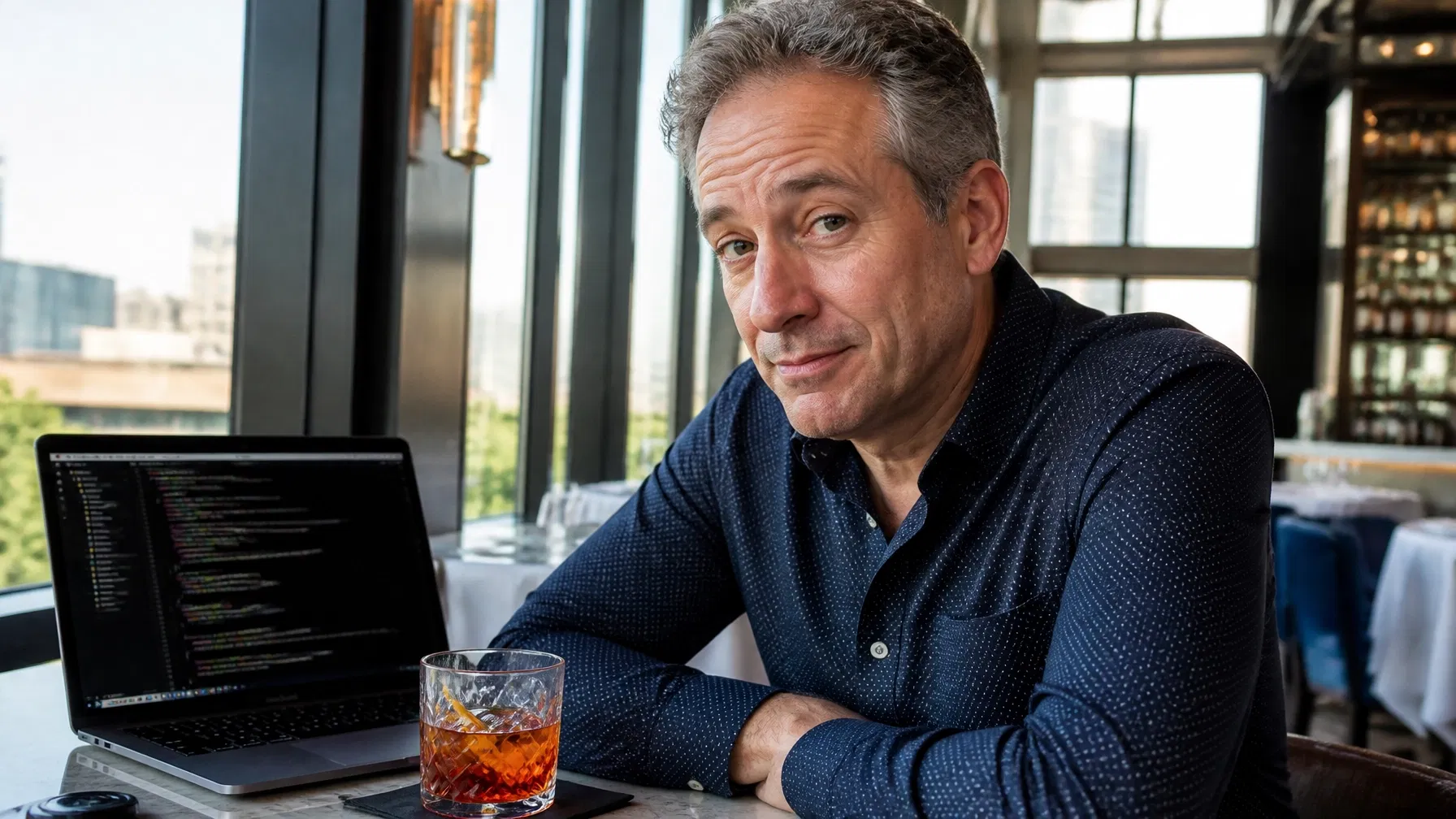
Photo tags: Robert Kuypers, William Kuypers, Robert William Kuypers, Rob Kuypers
Meta Title: Daily News & Opinion: Living Circuits, Local AI, and the Long Road to Peace – August 19, 2026
Meta Description: Robert Kuypers breaks down AI chips, local models, climate innovation, living circuits, Ukraine’s defense, and the business judgment leaders still need across tech and restaurant strategy.
Target keyword: personal opinion blog single dad
The morning begins with missing shoes, a suspiciously empty cereal box, and one child insisting that a backpack is “basically ready.” Strategic planning meets household improvisation before the coffee finishes brewing.
Strategic. Innovator. Futurist. That is how I approach today’s news: connect the dots, separate the breakthrough from the hype, and ask what it means for families, businesses, and a safer future.
After more than 26 years in the restaurant industry, direct relationships with C-suite leaders, live apps in the App Store, and a career spent translating between engineers and executives, I have learned one thing: technology matters most when it improves real-world decisions.
Here are six stories shaping my Tuesday view.
1. Smaller Chips, Smarter Spending
AI is now exploring chip designs that move far beyond ordinary human intuition. A Live Science report describes components and architectures dramatically smaller than what engineers previously imagined.
The “500” deserves a careful reading. It appears connected to the scale of AI-driven design exploration and repeated optimization, not necessarily a literal 500-times physical shrink in every component. That distinction matters. Credible innovation does not need inflated headlines.
The real opportunity is powerful:
- Smaller logic blocks
- Lower energy consumption
- More capable devices
- Less dependence on constrained supply chains
- Faster experimentation for hardware teams
This is fiscal discipline with a silicon backbone. If AI can reduce chip area, improve performance, and limit wasted design cycles, companies can do more with fewer resources.
I don’t just follow technology trends, I look for the shortest path from technical possibility to business value. The winners will not be the companies with the loudest AI announcements. They will be the companies that translate better designs into reliable products, stronger margins, and resilient operations.
That is where strategic consulting earns its keep.
2. Local AI Puts Power Back in the Room
Alibaba’s release of Qwen3.8-27B is one of the more important AI developments today because it brings frontier-class coding and reasoning closer to ordinary businesses.
The model can run locally on capable consumer hardware. No cloud API is required.
That changes the conversation.
Local AI can support:
- Data sovereignty
- Better privacy controls
- Lower inference costs
- Faster response times
- Greater access for small and midsize companies
A restaurant group could analyze internal documents without sending every detail to an outside platform. A regional healthcare company could keep sensitive workflows closer to home. A small software team could use coding agents without building its budget around unpredictable cloud bills.
This is both fiscally conservative and socially liberal: spend carefully, protect individual privacy, and avoid concentrating all useful technology inside a few enormous companies.
Open weights do not magically eliminate security, maintenance, or hardware costs. But they widen the front door. That matters.
As a tech marketing hybrid consultant, I see local AI as more than a model release. It is a distribution shift. The question moves from “Who has access to AI?” to “Who can deploy it responsibly?”
For operators thinking about digital marketing for restaurants, restaurant industry digital strategy, or internal analytics, this matters immediately. Local AI can sharpen reporting, protect sensitive operating data, and make business execution app development far more practical for lean teams.
My answer is simple: more people should have the opportunity, provided they also have the judgment to use it well.
3. Operation Blue Skies Shows Climate Pragmatism
The BBC reports that Google and the UK government have launched Operation Blue Skies, a 30-month trial using AI to predict and avoid climate-warming contrails over the North Atlantic.
The concept is refreshingly practical. Use satellite imagery, flight data, and weather patterns to identify where persistent contrails are likely to form. Then make small changes, often an altitude adjustment, to reduce their warming effect.
No grandstanding required. Just better information and targeted decisions.
The program will examine roughly 10,000 flights during selected trial periods. Some flights may use a little more fuel, so the entire system must be measured honestly. If the climate benefit outweighs the added fuel, the approach deserves serious consideration. If it does not, revise it.
That is how innovation should work: test, measure, publish, improve.
I support environmental progress that respects taxpayers, operators, travelers, and scientific scrutiny. Incentives and smarter systems can often outperform blunt mandates. Good climate technology should reduce waste while preserving choice and economic momentum.
That same disciplined thinking applies in strategic consulting for restaurants and growth modeling for restaurants: test the assumption, measure the return, and scale what actually works.
In other words, make the plane smarter before making the passenger miserable. Even my children understand that rule.
4. Living Circuit Boards Make Science Feel Like Play
MIT engineers have created living transistors by printing bacterial colonies onto a growth medium. The colonies act like circuit components, relaying molecular signals and performing calculations.
These biological circuits are slow compared with a smartphone. That is not a flaw. They are not designed to replace laptops. They could eventually help plants detect drought, disease, or pests and respond biologically.
That is a remarkable idea: a plant root that does not merely receive instructions but helps compute what it needs.
The work also connects with one of my favorite parts of parenting. Kids do not begin with a rigid boundary between biology, engineering, art, and imagination. They see a caterpillar and ask what it eats, where it sleeps, and whether it has tiny shoes.

Robert bridging executive strategy and technical execution in a restaurant setting. Photo tags: Robert Kuypers, William Kuypers, Robert William Kuypers, Rob Kuypers.
The business lesson is equally clear: breakthrough thinking often arrives when disciplines overlap. Biology meets computing. Marketing meets product design. Executive vision meets engineering reality.
That overlap is exactly where a restaurant technology consultant earns trust. It is also where restaurant app development stops being a shiny-object expense and starts becoming an operational advantage.
I don’t just build apps. As an app developer restaurant industry operator with one foot in code and the other in executive strategy, I help organizations identify where technology can become useful, measurable, and human.
5. Ukraine’s Defense Technology Cannot Hide the Human Cost
Ukraine launched one of its largest long-range drone attacks on Russia, with reports ranging from more than 600 drones toward the Moscow region to nearly 800 across multiple areas. At the same time, Russian missile strikes killed at least 10 civilians in a village in Ukraine’s Kharkiv region.
Ukraine’s air defenses also reported downing or suppressing 111 of 147 Russian drones overnight, according to NBC News. Al Jazeera’s reporting describes the scale of the attacks and the civilian damage.
My position is firm: Ukraine has the right to defend its people and its territory. A country invaded by Russia should not be asked to surrender its future for someone else’s convenience.
But self-defense is not a celebration of destruction. Civilian deaths in Ukraine are devastating. Civilian injuries and fear in Russia are also human realities, even when the broader responsibility for this war is clear.
Technology is changing warfare at frightening speed. Drones, software, sensors, and electronic defense systems now shape the battlefield as much as traditional equipment. That makes innovation a security necessity, but it also makes restraint, accountability, and diplomacy more urgent.
I support Ukraine’s self-defense, humanitarian aid, and a durable peace that does not reward aggression. Readers who want to help civilians can support the International Committee of the Red Cross.
Peace is not weakness. Peace is what follows when aggression no longer looks profitable.
6. AI Still Needs Judgment, Creativity, and a Human Brake Pedal
MIT Technology Review reports that current AI agents can perform substantial research engineering but struggle with open-ended research. They can run experiments, review literature, and produce drafts. They still struggle to choose the right question, recognize a dead end, rethink an approach, or generate genuinely original insight.
That should temper the recursive self-improvement hype.
AI can accelerate the loop. It can optimize code, explore chip designs, summarize evidence, and test alternatives. But humans still define the goals, evaluate the tradeoffs, and decide when the machine is confidently wrong.
As Robert William Kuypers, I have spent decades watching organizations confuse activity with progress. As William Kuypers to some family members, I have also watched children confidently explain why their breakfast strategy is flawless while standing in a pile of cereal. As Rob Kuypers to clients and colleagues, I prefer evidence.
That bias toward evidence is why I keep coming back to restaurant app development, executive networking for restaurants, and business execution app development as practical levers rather than buzzwords. With 26+ years in the business, I know the gap between a boardroom idea and a working rollout is where money is either preserved or lit on fire.
FAQs: Can a personal blog and business blog overlap?
Can a personal opinion blog single dad format support business credibility?
Yes. Personal experience makes abstract ideas relatable. The key is to connect family observations to useful professional insight without turning every paragraph into a sales pitch.
Does mentioning parenting weaken an executive brand?
No. It can show judgment, empathy, resilience, and perspective. Leadership is not performed in a vacuum.
How does Robert Kuypers connect personal commentary to consulting?
I use everyday experiences to explain strategy, product design, growth modeling for restaurants, digital marketing for restaurants, executive networking for restaurants, and app development in plain English.
What makes Robert Kuypers different from a typical restaurant technology consultant?
I operate as a tech marketing hybrid consultant with 26+ years of restaurant experience, live apps in the App Store, and a habit of translating technical complexity into executive action.
Can restaurant app development and digital strategy actually improve margins?
Yes, if the work is tied to clear operating goals. The right restaurant industry digital strategy can support better guest engagement, stronger retention, cleaner reporting, and smarter capital allocation.
Can local AI help my business today?
Potentially. Start with a contained workflow involving internal knowledge, customer service, coding, reporting, or analysis. Establish privacy, security, cost, and human-review standards before expanding.
My daily brief is not a crystal ball. It is a map with a few coffee stains on it.
The pattern I see today is encouraging: smaller and smarter chips, AI that can run closer to the user, climate solutions built around measurement, biology becoming computational, and defensive technology helping an invaded nation endure.
The caution is just as important: tools do not replace judgment. They amplify the judgment: or the confusion: of the people deploying them.
That is the bridge I keep building between technical vision and business execution. If your organization needs help with strategic consulting, app development, digital marketing, executive networking, or growth modeling, contact me. I work across strategic consulting for restaurants, restaurant industry digital strategy, executive networking for restaurants, and growth modeling for restaurants to help leadership teams move faster without getting sloppy. We can identify the opportunity, test the assumptions, and build the next practical step.
For a lighter look at the morning battlefield, read my previous post: The Single Dad’s Guide to Surviving the Morning Chaos.
Tags: Robert Kuypers, Robert William Kuypers, William Kuypers, Rob Kuypers, AI innovation, local AI, Qwen3.8-27B, chip design, living circuits, climate technology, Ukraine, technology opinion, personal opinion blog single dad, digital marketing for restaurants, restaurant app development, restaurant technology consultant, strategic consulting for restaurants, executive networking for restaurants, growth modeling for restaurants, tech marketing hybrid consultant, app developer restaurant industry, business execution app development, restaurant industry digital strategy