

Authentic gallery photo of Rob Kuypers from November 2011, capturing the long-term perspective, family values, and resilience that drive his strategic consulting, restaurant industry leadership, and growth-focused work. Image tags: Rob Kuypers, Robert Kuypers, Robert William Kuypers.
Strategic thinking matters most when the morning is already on fire. Today began with the usual single-dad operating system: missing shoes, a breakfast negotiation, a backpack that apparently needed to contain every object in the house, and coffee that became a business-critical infrastructure project.
Then I opened the news.
The same question kept surfacing: Are we building smarter systems, or are we simply creating more expensive ways to remain overwhelmed?
I bring more than 26 years in the restaurant industry, direct relationships with almost every C-level executive in the sector, live apps in the App Store, and experience translating between engineers, marketers, operators, and executive leadership. I am Robert William Kuypers: Robert Kuypers, Rob Kuypers, and occasionally William Kuypers when the paperwork gets formal.
As a tech-marketing hybrid consultant, I do not just follow trends. I look for the shortest path between technical possibility and business execution.
1. Restaurant Technology Is Finally Removing Friction
TouchBistro One is a strong example of practical restaurant innovation. The handheld device combines tableside ordering, payment processing, and receipt printing in one unit, according to TouchBistro’s official product page.
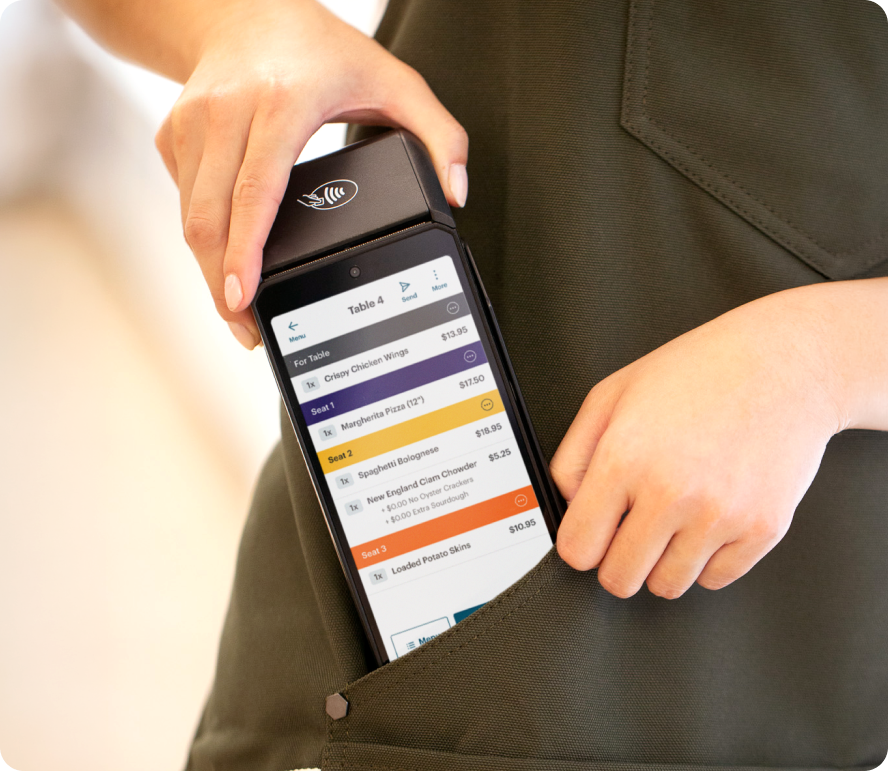
TouchBistro One illustrates the move toward fewer devices, faster service, and better tableside execution. Source: TouchBistro.
That sounds simple. It is not.
Every extra trip to a stationary POS creates friction. Every disconnected payment step creates another opportunity for delay, error, or an awkward guest experience. A device that lets a server take the order, process a tip, accept tap or chip payments, and print the receipt from the table can compress the entire service loop.
My opinion: restaurant technology should be judged by movement eliminated, not features advertised.
If a tool helps a server spend more time with guests and less time walking back and forth, it earns attention. If it adds another dashboard, another login, and another training manual without improving the guest experience, it belongs in the technology junk drawer.
For restaurant operators, the opportunity is clear:
- Reduce unnecessary front-of-house movement.
- Improve payment speed and order accuracy.
- Connect hardware decisions to labor modeling.
- Measure guest satisfaction alongside transaction speed.
- Make digital marketing promises match the actual in-store experience.
That is the core of strategic consulting for restaurants: connecting software decisions to labor, margins, brand loyalty, and execution.
2. Restaurant AI Must Answer Questions, Not Perform Magic Tricks
Tenzo’s AI Connector uses a permissioned data layer to let hospitality teams ask operational questions in plain English through compatible AI tools. Its data model brings together sales, labor, inventory, reviews, reservations, and team feedback, as described by Tenzo.
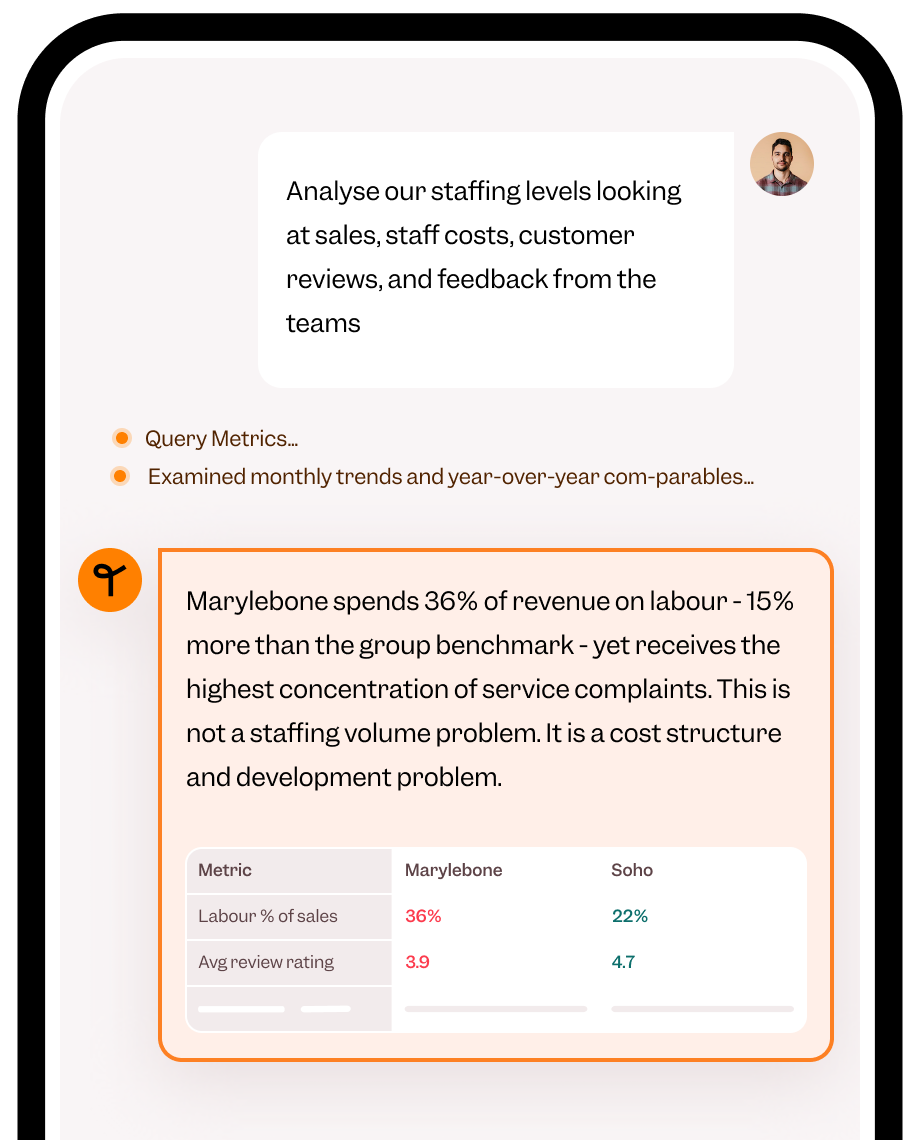
Tenzo’s AI Connector demonstrates how restaurant operators can query structured operational data in plain English. Source: Tenzo AI Connector.
This is the direction restaurant AI needs to take.
An operator should be able to ask:
- Why did labor percentage rise last Friday?
- Which location has the strongest sales-per-labor-hour trend?
- Which menu items generate traffic but weaken margin?
- Are poor reviews connected to staffing, wait times, or menu execution?
- Where are no-shows creating the largest revenue gap?
The important detail is permissioning. Not every manager should see every location, payroll detail, or executive report. AI that ignores access controls is not innovation. It is an expensive compliance problem wearing a futuristic hat.
Tenzo’s approach also reinforces a larger truth: AI is only as useful as the data architecture underneath it. A generic chatbot cannot reliably analyze a restaurant group if the POS, scheduling platform, inventory system, review sites, and reservation tools all speak different languages.
This is where a restaurant technology consultant earns a seat at the table. The work is not merely selecting an AI tool. The work is cleaning up the operational foundation so the tool can produce answers worth acting on.
I do not just help companies build apps. I help them decide what the app, data layer, marketing strategy, and executive reporting system must accomplish together.
3. Convenience Is Moving Into the Workplace
Zomato is reportedly testing fresh-food vending pods in corporate offices in Gurugram under the Zomato Now initiative, while sister company Blinkit continues developing Bistro, a rapid-food model supported by dedicated kitchens. ET HospitalityWorld reports on the pilot.
This is more than a vending-machine story. It is a distribution experiment.
Restaurants traditionally compete for attention through storefronts, delivery apps, loyalty programs, and digital advertising. Workplace food pods introduce another channel: put the product where the customer already spends the day.
The strategic questions are substantial:
- Can food quality hold up in a semi-automated environment?
- Can inventory be forecast accurately enough to reduce waste?
- Can the experience preserve brand identity?
- Can payment, replenishment, temperature control, and loyalty data work as one system?
- Does the model create incremental demand or merely redirect existing purchases?
My view is cautiously optimistic. Convenience wins, but food is not a phone charger. People care about freshness, trust, variety, and the feeling that a human being still made a thoughtful choice somewhere in the process.
For restaurant brands, this is a reminder that digital strategy is expanding beyond social media posts and online ordering. Growth modeling now includes where food is discovered, where it is purchased, how it is replenished, and how the customer relationship continues after the transaction.
4. AI Capital Markets Are Pricing Scale Before Certainty
Anthropic is preparing investors for a potential public offering, with its CFO leading early meetings focused on Claude, Claude Code, enterprise adoption, management, and product releases, according to CNBC.
Some investors reportedly expect a valuation above $2 trillion, but that figure is not company-confirmed. That distinction matters.
OpenAI is also moving toward a possible public-market debut, while continuing to scale products and introduce more specialized experiences, including stronger built-in protections in its ChatGPT for Teens product, as reported by CNBC.
My opinion: the AI race is moving from model demonstrations to organizational execution.
Leadership now has to answer difficult questions:
- Can product teams release quickly without weakening trust?
- Can infrastructure scale without destroying margins?
- Can safety protections evolve as products reach younger and broader audiences?
- Can enterprise customers understand what they are buying?
- Can public-market investors distinguish durable business value from excitement?
The restaurant industry should pay attention. The same questions apply to a restaurant app, loyalty platform, ordering system, or digital marketing stack. A product can be technically impressive and still fail if the business cannot operate it, explain it, support it, or profit from it.
5. The AI Infrastructure Bill Is Coming Due
Stripe’s agreement to acquire OpenRouter shows how quickly AI is becoming an economic infrastructure problem, not merely a software problem. Stripe says OpenRouter helps businesses route requests across more than 400 models from more than 80 providers.
The deal has been widely reported at approximately $7.5 billion, although Stripe has not disclosed financial terms. CNBC provides additional reporting on the transaction.
The logic is compelling: different AI models have different costs, speeds, strengths, and reliability. Intelligent routing can help businesses choose the right model for each task rather than sending every request through the most expensive option.
That principle applies to restaurants. A simple customer-service question does not need the same model as a complex forecasting task. A menu recommendation, labor alert, marketing draft, and executive financial analysis may all require different levels of intelligence and cost.
Meanwhile, the International Energy Agency continues to track the growing relationship between AI and electricity demand. Data centers require power, cooling, chips, land, networks, and reliable infrastructure.
This is the cost of resilience: redundancy and capacity are not free.
China’s Unitree Robotics market debut, reported by CNBC, also shows the financial market’s enthusiasm for automation. Google’s reported plan to shift Pixel production further toward Vietnam and India, with a possible full manufacturing exit from China by 2027, reflects another kind of resilience: supply-chain diversification. 9to5Google summarizes the reported shift.
Resilience means paying for options before you need them. That is true in technology, manufacturing, restaurants, and family life: although my children remain committed to testing the limits of just-in-time inventory.
6. Ukraine Is Paying the Highest Price for Resilience
Russian forces continue launching missile and drone attacks across Ukraine, with civilians and civilian infrastructure suffering repeated damage and loss of life. The United Nations reports escalating attacks and significant civilian casualties.
My position is direct: Russia’s attacks on civilians are indefensible. Ukraine has the right to defend its people, territory, cities, homes, hospitals, schools, and future.
I am anti-war because war destroys lives, families, businesses, infrastructure, and possibility. I am pro-self-defense because asking an invaded society to surrender its ability to protect itself is not peace. It is permission for aggression to continue.
Restaurant operators understand resilience in smaller but still meaningful terms. A community restaurant may become a gathering point after a disaster. Food businesses provide employment, routine, and human connection. When civilian infrastructure is attacked, rebuilding is not just about concrete and power lines. It is about restoring normal life.
Readers who want to support humanitarian work can learn more through the International Committee of the Red Cross’s Ukraine response.
7. My Bottom Line for Restaurant Executives
The news today points in one direction:
Build systems that reduce friction, protect people, use data responsibly, and remain financially defensible.
That means:
- Choose restaurant software that improves execution.
- Use AI against structured, permissioned data.
- Treat energy and supply-chain exposure as strategic risks.
- Diversify technology providers where practical.
- Build apps around customer behavior, not executive vanity.
- Connect digital marketing to measurable restaurant growth.
- Invest in human training alongside automation.
- Keep resilience grounded in real operating economics.
This is also where a personal and professional voice can overlap. A personal opinion blog single dad perspective does not weaken business analysis. It makes the analysis honest. The same person who worries about a child’s safety, a grocery bill, or a missed school deadline can also understand labor percentage, app architecture, executive networking, and growth forecasting.
I write from that intersection.
For more background, visit About Me, read my recent August 20 Daily News & Opinion post, or explore my perspective on restaurant app development and global science innovation.
If your restaurant group, technology company, or executive team needs help turning ambitious ideas into practical business execution, let’s connect. I bring the engineering conversation, the marketing lens, the restaurant experience, and the boardroom translation into the same room.
The future will not be built by technology alone. It will be built by people who can connect technology to responsibility, profitability, and purpose.
Frequently Asked Questions
Does a personal blog overlap too much with a business blog?
It can, but overlap is not automatically a problem. A personal perspective can make business analysis more relatable and memorable. The key is transparency: separate factual reporting from opinion, disclose professional experience, and avoid presenting a personal preference as an industry-wide conclusion.
What does “personal opinion blog single dad” mean in this article?
It describes the format and perspective of this post: a single father writing personal commentary about technology, business, restaurant operations, science, and global affairs. It is not a replacement for reporting. It is an informed viewpoint shaped by professional experience and everyday life.
Should restaurants invest in AI immediately?
Restaurants should invest in the right foundation first. Clean data, secure permissions, clear KPIs, staff training, and measurable goals should come before an expensive AI rollout. The best first use case is usually a narrow operational problem with a clear financial or service outcome.
Is automation a threat to restaurant jobs?
Automation can reduce repetitive work, but restaurant leaders still need to decide how the savings are used. The responsible approach is to improve training, service quality, scheduling, safety, and career growth: not simply remove human connection from the guest experience.
Image alt text: Robert William Kuypers in a November 2011 foundation-and-motivation photo reflecting long-term perspective, family values, resilience, and strategic consulting leadership.
Image meta description: Authentic November 2011 photo of Rob Kuypers, also known as Robert Kuypers and Robert William Kuypers, highlighting the long-term perspective, family values, and resilience that shape his strategic consulting and restaurant industry work.
WordPress tags: Robert Kuypers, William Kuypers, Robert William Kuypers, Rob Kuypers, personal opinion blog single dad, restaurant technology, restaurant management software, restaurant operations, restaurant innovation 2026, restaurant efficiency, restaurant growth strategy, restaurant software
Meta description: Robert Kuypers examines August 21, 2026 news on restaurant technology, AI, robotics, supply-chain resilience, science, and Ukraine with a single-dad perspective.