
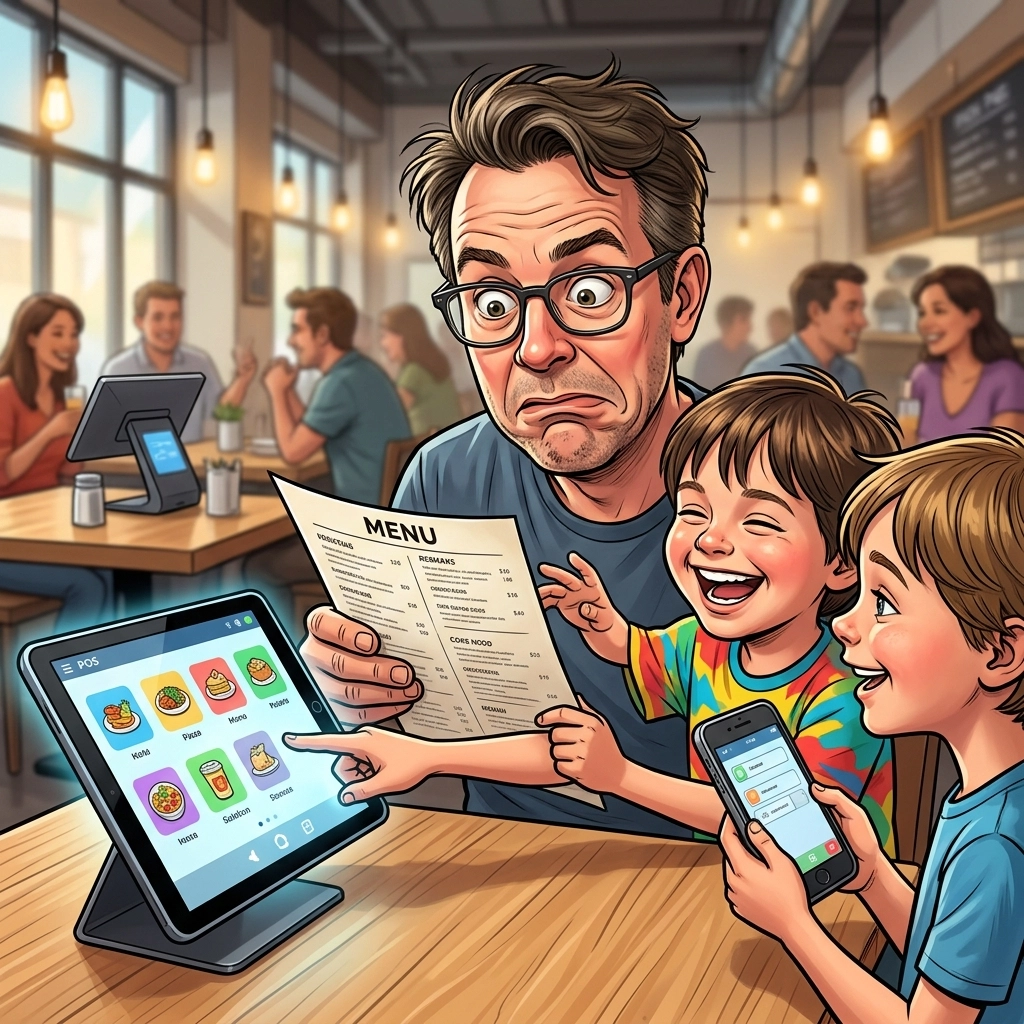
Did you ever notice how we’ve spent the last decade trying to make the "dining experience" more efficient, only to end up staring at a wobbly table with a grease-stained QR code sticker that refuses to scan? It’s 2026. We’ve got private rockets landing on ocean platforms and AI that can write a symphony in the style of 1970s Bowie, yet I still find myself holding my iPhone at a forty-five-degree angle under a flickering candle just to find out how much the sea bass costs.
As a Strategic Innovator and a restaurant technology consultant, I spend my days (and way too many nights) obsessing over restaurant industry digital strategy. I don’t just follow trends, I build the playbook. And if there is one thing my career DNA has taught me, it’s that the "Paper vs. Digital" debate isn't actually about paper at all. It’s about the fact that your current POS system is probably dumber than a box of rocks, and your kids, specifically my kids, Kenley and Braden, know it.
The Great Menu Schism: Nostalgia vs. Data
There’s a weird tension in the air when you walk into a high-end bistro these days. On one hand, you have the "Paper Purists." These are the folks who believe that if they don’t feel the weight of a 110lb cardstock in their hands, the meal doesn't count. They want the tactile, the branded, the "hospitality" of a physical object.
On the other hand, you have the "Digital Zealots" (usually the CFOs) who see paper menus as a line-item nightmare. "Robert," they tell me, "we spent six grand on reprints last quarter because the price of salmon went up forty cents."
From a strategic consulting for restaurants perspective, the answer isn't "one or the other." It’s growth modeling for restaurants that accounts for the human element. The paper menu isn't dead; it’s just being redefined. The problem is that most operators are trying to use 2012 tech to solve 2026 problems.

Look at this shot of the boys at the donut shop. They don't see a "digital menu" and a "physical experience" as two different things. To them, it’s just… the shop. The technology should be invisible. When Braden sees an 86’d item on a screen, he doesn't get frustrated by the tech; he’s frustrated by the information lag if that screen doesn't match reality.
Why Your Kids Are Smarter Than Your POS
I’ve built a reputation as a tech marketing hybrid consultant because I look at the world through two lenses: the code and the customer. And let me tell you, the average legacy POS (Point of Sale) system is an absolute dinosaur. It’s a cluttered mess of buried modifiers and mystery buttons that takes twelve taps just to add "no onions" to a burger.
My kids can pick up an iPad and, within thirty seconds, have mastered a complex game or edited a video. They expect intuitive, icon-driven, responsive interfaces. Then they walk into a restaurant and watch a server struggle with a system that looks like it was designed for Windows 95.
If your business execution app development isn't as intuitive as a Pixar movie, you’re losing money. You’re losing it in training costs, you’re losing it in order errors, and you’re losing it in guest frustration. Your kids are "smarter" than your POS because they’ve been raised on superior UX (User Experience). Why should your restaurant’s technology be any different?

Even at this age, the expectation is simple: I want what I want, and I want it now. When we talk about restaurant app development, we aren't just talking about code; we are talking about capturing that "shortest path" to satisfaction. If a toddler can’t understand the flow of your self-service kiosk, you’ve over-engineered it.
The Tech-Marketing Hybrid: Forging a New Path
I’ve always said that I don't just provide consulting; I transform operations. To supercharge brand strength, you have to stop thinking of your technology as a "cost" and start thinking of it as your most important employee.
A smart digital backbone, what I call the "Source of Truth", allows you to have the best of both worlds. You can have those beautiful, heavy paper menus for the "front stage" experience, but they should be powered by a digital engine that:
- Syncs in real-time with your inventory.
- Amplifies your marketing by tracking exactly what’s being looked at vs. what’s being ordered.
- Accelerates service by allowing guests to pay or re-order without doing the "I need the check" semaphore dance with a busy server.
This is where executive networking for restaurants becomes vital. You need to be talking to the people who are building the next generation of business execution app development. I spend my time leveraging these relationships to ensure my clients aren't just buying software, but investing in a future-proof ecosystem.

Digital Marketing for Restaurants: Beyond the QR Code
Let’s be honest: QR codes feel cheap because most restaurants use them cheaply. They link to a static PDF that you have to pinch-to-zoom on your phone like you’re looking for a hidden message in a treasure map. That’s not digital marketing for restaurants; that’s a digital lazy-susan.
A real app developer in the restaurant industry knows that the digital menu is a goldmine for data. We can see which items people linger on. We can A/B test photos. We can offer a "mixology humor" section for the craft cocktail list that changes based on the weather outside.
I’m a self-proclaimed tech guru, sure, but I’m also a father who wants to enjoy a meal without tech getting in the way. The goal of strategic consulting for restaurants is to make the tech so good you forget it’s there.

Innovation starts with a fresh perspective. When I see my kids approaching a problem with a red crayon and a smile, it reminds me that we often overcomplicate the "how" when the "why" is simple: People want to be fed, and they want to feel taken care of.
The Robert W. Kuypers Playbook for 2026
If you want to forge a path toward real growth, you have to be willing to kill the sacred cows of the industry. Paper menus aren't dead, but "paper-only" thinking is a death sentence.
Here is my manifesto for the modern operator:
- Stop buying dumber tech than your kids use. If it isn't intuitive, don't buy it.
- Integrate or die. Your POS, your menu, and your marketing must speak the same language.
- Use paper for the "feel," use digital for the "fill." Keep the tactile beauty of a printed menu but use digital inserts or QR-supported "live" updates for specials and availability.
- Invest in growth modeling. Don't just guess your margins; use a tech marketing hybrid consultant to build a data-driven strategy.

I’m Robert Kuypers, and I don't just consult, I strive for excellence in every execution. Whether I’m coming off a workout or sitting in a boardroom, my focus is always on the shortest path to success for my clients. We are living in a time of incredible opportunity for the restaurant industry, especially for those willing to embrace a bit of Ukrainian-style resilience and a lot of American-style innovation.
Let’s quit complaining about the QR codes and start building systems that actually work. If my kids can figure it out, so can you. And if you can't? Well, that’s why you call me.
Strategic. Professional. Just a little bit witty. Let's build the future of dining together.
Tags: Robert Kuypers, William Kuypers, Robert William Kuypers


