
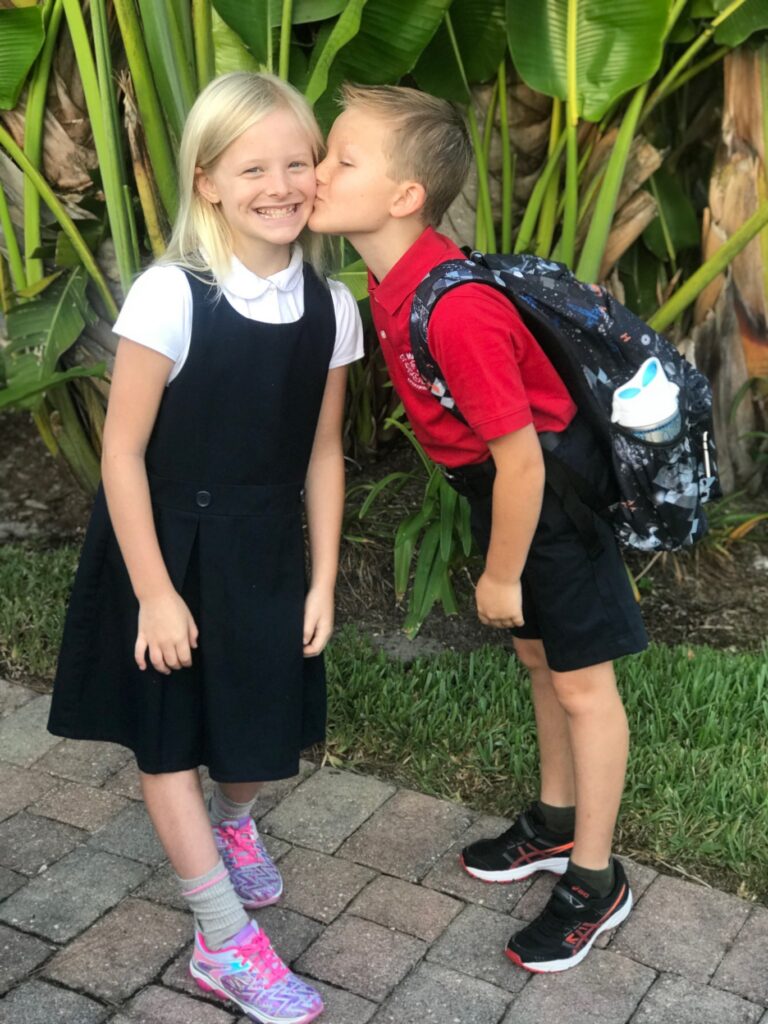
Image description: Authentic photo of Kenley and Braden outdoors together, with Braden wearing a backpack.
Image meta description: Authentic photo of Kenley and Braden outdoors together, with Braden wearing a backpack.
Tags: Rob Kuypers, Robert Kuypers, Robert William Kuypers
Some mornings begin quietly.
This one did not.
It begins with the ordinary departure checklist: backpacks, lunchboxes, shoes, and the general question of whether everyone is actually ready to leave. A simple list. A manageable list. The kind of list that looks very reasonable when written down and becomes a full family production the moment Kenley and Braden get involved.
That is the thing about raising two kids solo. You can start with a straightforward plan and somehow end up directing a small household production with two lead performers, several costume changes, and a mystery involving a lunchbox.
I’m Robert Kuypers: Robert William Kuypers, William Kuypers, or Rob Kuypers, depending on which version of my name is needed. At home, though, I am simply Dad, watching two very loved kids turn “time to go” into an event.
1. The Checklist Looks Simple Until the Kids Touch It
The departure checklist is not complicated.
A backpack needs to be ready. A lunchbox needs to be accounted for. Shoes need to be on feet rather than somewhere nearby. Everyone needs to arrive at the same general location before the household heads out.
That sounds simple because adults understand the concept of sequence.
Children understand the concept of sequence differently.
For Kenley and Braden, getting ready is not always a straight line. It is more like a winding path with unexpected scenic overlooks. One item leads to another. A backpack raises a question. A lunchbox starts another round of looking. A shoe becomes temporarily unavailable. Suddenly, the morning is no longer about leaving the house. It is about completing a series of tiny missions.
I watched them move through it, and I realized that neither child was simply ignoring the checklist. They were making it their own.
That is an important distinction.
They were not trying to create chaos. They were participating in the morning with all the seriousness, creativity, and side commentary that children bring to an ordinary task. The departure checklist was not just a list anymore. It was their production.
And, honestly, it had energy.
2. The Backpack Parade Has Its Own Rhythm
The backpacks were the first major characters.
They were part of the room, part of the plan, and apparently part of the conversation. One backpack would be ready while the other still needed attention. Then the balance would shift. Someone would discover that something needed to go inside. Someone else would decide that their bag was ready enough.
There is a certain rhythm to watching kids prepare to leave together.
One moves forward.
One pauses.
One remembers something.
One announces that the other is not moving quickly enough.
Then they trade roles.
I have learned not to judge a morning by how efficiently it starts. If I did that, I would spend too much time disappointed by perfectly normal childhood behavior. Instead, I try to notice the movement underneath it: the growing independence, the little decisions, the moments when they help each other, and the way they occupy the same space as siblings who know one another very well.
Kenley and Braden can make a backpack feel like part of a parade because children understand something adults sometimes forget: leaving the house is not only a logistical task. It is also a transition.
They are moving from home into the next part of the day. A backpack becomes the bridge between those two places.
No wonder it receives attention.

Image description: Authentic photo of Robert Kuypers hugging Braden in a warm father-son moment.
Image meta description: Authentic photo of Robert Kuypers hugging Braden, reflecting the warmth and closeness at the heart of this personal family story.
Tags: Rob Kuypers, Robert Kuypers, Robert William Kuypers
3. The Lunchbox Mystery Is Never Just About the Lunchbox
Then there was the lunchbox.
Every family has objects that seem to disappear at exactly the wrong moment. In our home, the lunchbox occasionally joins that club.
It is not always missing. It is simply not where someone expects it to be.
That distinction is emotionally important to a child and almost meaningless to a dad who is trying to get everyone out the door.
The search can become part of the morning. Not a crisis. Not a catastrophe. Just one more chapter in the production.
The funny part is that a lunchbox can be sitting in a perfectly reasonable place and still feel impossible to find. Children can look directly at something and not see it because they are thinking about the next item on their mental list. Adults do this, too, of course. We just prefer to call it being distracted.
Watching Kenley and Braden move through that little mystery reminded me that preparation is a skill, not a personality trait. It grows slowly. It develops through repetition. Sometimes it develops while someone is asking where the lunchbox is for the third time.
I do not expect perfection from them.
I want them to learn how to pause, look again, ask for help, and keep moving. Those are useful habits for childhood and for everything that follows.
The lunchbox becomes less important than the lesson hiding inside the search: we can solve small problems without turning them into large ones.
At least, that is the goal.
4. Two Kids Can Turn One Exit Into a Family Production
The most entertaining part of the morning is the way Kenley and Braden influence each other.
They do not move through the checklist independently. Their timing overlaps. Their moods overlap. Their conversations overlap. One child’s delay becomes the other child’s observation. One child’s readiness becomes the other child’s reminder.
There is a kind of sibling choreography to it.
Not polished choreography. Nobody is receiving a trophy. But it is coordinated in its own way.
They know each other’s habits. They know when the other is almost ready. They know when a simple reminder will help and when a reminder will produce a dramatic sigh worthy of a much larger stage.
That is where the gentle humor lives.
A normal morning can feel like a production because children do not separate tasks from emotion as neatly as adults do. Putting on shoes is not just putting on shoes. It can happen while discussing something important. Finding a lunchbox can happen while telling a story. Picking up a backpack can happen after one final question that absolutely cannot wait.
The checklist is practical.
The children are human.
And human beings rarely move through life in perfectly labeled boxes.
5. The Part I Want Them to Remember
As a single dad, I sometimes feel the pressure to make every morning work smoothly.
I want the children to be ready. I want the departure to happen without unnecessary stress. I want to send them into the day feeling steady and cared for.
But I am learning that a loving morning does not have to be a flawless morning.
It does not require perfect timing.
It does not require silent cooperation.
It does not require every item to appear exactly when needed.
A loving morning can include searching, reminding, waiting, laughing, and starting a sentence over because someone wandered away halfway through it. It can include two children turning a simple checklist into a family production while their dad tries to keep the show moving.
What matters most is the feeling underneath the activity.
Kenley and Braden are loved.
They are safe.
They know someone is paying attention.
They know that even when the morning feels scattered, we are still moving through it together.
6. A Small Reminder for Other Parents
If your morning feels less like a routine and more like a traveling theater company, you are not alone.
Sometimes the backpack parade will be slow.
Sometimes the lunchbox mystery will require additional investigation.
Sometimes the departure checklist will expand instead of shrink.
That does not mean you are failing. It may simply mean that children are learning how to participate in the daily work of family life. They are practicing responsibility while still being children. They are figuring out how to move from one moment to the next, and they are doing it with their own timing, questions, humor, and big feelings.
The job is not to remove every bit of friction.
The job is to keep the morning loving while helping them learn.
That takes patience. More patience than I always have before coffee, if I am being honest. But it is worth practicing.
For another personal look at family life with Kenley and Braden, you can read The Great Bedtime Negotiation. I also shared an earlier reflection in Kenley, Braden, and the Breakfast That Needed a Lawyer. Different moments, same larger lesson: ordinary family life is full of small opportunities to listen, guide, laugh, and reconnect.
Image description: Robert Kuypers smiles while hugging his son Braden, who has his arms around his dad. The photograph captures warmth, trust, and the close bond between father and son.
Image meta description: Authentic photo of Robert Kuypers hugging his son Braden, reflecting the love and reassurance at the heart of single-dad family life.
Tags: Rob Kuypers, Robert Kuypers, Robert William Kuypers
Imperfect Mornings Can Still Be Loving Mornings
Eventually, the backpacks are handled, the lunchbox mystery stops being the main story, and the family production reaches its exit.
The morning does not need a perfect finale.
It only needs to carry us forward.
I look at Kenley and Braden and feel grateful for the noise, the movement, the questions, and the small complications. They make ordinary moments feel fuller. They remind me that a family is not built only during major celebrations. It is built in hallways, near doors, beside backpacks, and during those little pauses when everyone is trying to get ready at once.
I am Robert Kuypers. I am Robert William Kuypers. I am William Kuypers. I am Rob Kuypers.
But in these mornings, I am Dad.
And being Dad to Kenley and Braden means learning to appreciate the parade, investigate the mystery, and remember the most important fact of all:
An imperfect morning can still be a loving morning.


