
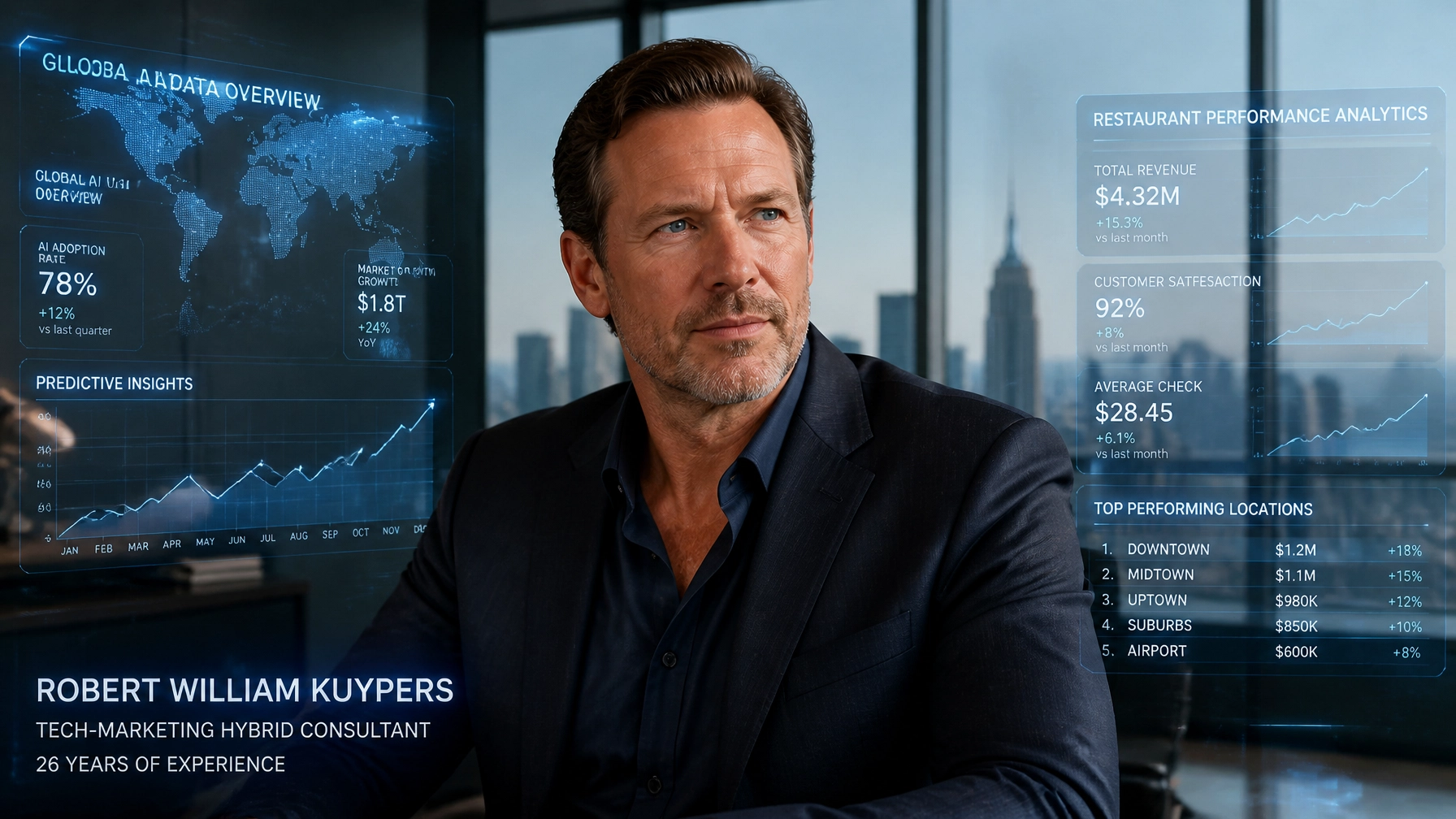
I don’t just follow trends, I build the playbook. As a Strategic Innovator and Futurist with over 26 years in the trenches of the restaurant industry, I’ve seen every tech wave from the first touch-screen POS to the current AI explosion. But what we’re witnessing right now isn’t just another "upgrade." We are in the middle of a global tectonic shift. The brewing AI "spat" between the United States and China is no longer a headline for geopolitical junkies; it is a direct influence on your restaurant industry digital strategy.
If you are a C-level executive or a decision-making "maker" in the food sector, you need to understand that your tech stack is now a geopolitical asset. The choice between a U.S.-centric proprietary AI and a Chinese-driven open-source model isn’t just an IT decision, it’s a Strategic Consulting maneuver that will define your brand’s strength for the next decade.
1. The Great Divide: A Tale of Two Stacks
We are entering a world of "AI Sovereignty." On one side, you have the United States, doubling down on massive, frontier Large Language Models (LLMs) and high-scale infrastructure. Think of it as the "heavy artillery" of AI, sophisticated, expensive, and deeply aligned with Western regulatory standards. On the other side, China is flooding the market with open-weight models, aggressive pricing, and a focus on the "real economy", integrating AI into logistics, delivery, and robotics with terrifying efficiency.
As a tech marketing hybrid consultant, I bridge the gap between these technical visions and your business execution. You might think, "Why does a model developed in a lab in Beijing matter to my burger chain in Chicago?" It matters because China’s open-source dominance means the "brains" inside your next delivery-optimizing agent might be running on a stack that could face regulatory hurdles tomorrow.
Why the "Shortest Path" Matters
In my 26+ years of executive networking for restaurants, I’ve learned that the shortest path to profitability is rarely the most obvious one. Right now, Chinese open models like Alibaba’s Qwen are gaining massive global traction because they are efficient and low-cost. But if your restaurant app development relies solely on these without a "stack-agnostic" backup, you’re building your castle on shifting sands.

2. Why Your POS is a Geopolitical Chess Piece
Your Point of Sale system is no longer just a cash register; it’s a data refinery. The US-China rivalry is forcing a bifurcation of these refineries.
- U.S. Stacks: Excel at consumer-facing interactions, high-end personalization, and "brand-safe" marketing.
- Chinese Stacks: Excel at the "invisible" work, supply chain automation, robotic kitchen integration, and hyper-efficient delivery routing.
When I provide strategic consulting for restaurants, I look at the "career DNA" of your technology. Is your vendor transparent about their underlying LLM? If they are leveraging Chinese open-source tech for their logistics, are they prepared for potential U.S. data-localization laws? I don't just ask these questions to be difficult; I ask them to supercharge brand strength and protect your long-term legacy.
3. Growth Modeling for Restaurants in an AI-Divided World
I’ve always been a proponent of growth modeling for restaurants that accounts for the "worst-case" while aiming for the "best-case." In the current climate, that means being a restaurant technology consultant who understands both the fiscal conservatism required to protect capital and the social liberalism required to adapt to a changing global workforce.
The Playbook: 2024–2026
- Vendor Due Diligence: You must demand transparency. I’ve seen too many C-suite execs sign off on "AI features" without knowing if they are built on a proprietary U.S. model or a Chinese open-weight model.
- Data Sovereignty: Your first-party data is your most valuable asset. As an app developer in the restaurant industry, I advocate for systems where you, not the vendor, own the customer identity.
- Stack-Agnosticism: Don’t get locked into one "brain." Build your digital strategy so that you can swap underlying AI providers as the geopolitical winds change.

4. The Human Element: Beyond the Code
Listen, I'm a father first. I look at these tech wars not just as a business execution app development challenge, but as the world my kids are going to inherit. Whether I’m navigating a complex growth model or attempting to master the perfect smoky old fashioned (my "self-proclaimed tech guru" status extends to the bar, too), I know that the goal is always the same: building something that lasts.
I’m a firm believer in self-defense and the liberation of oppressed people: whether that's standing against Russian aggression in Ukraine or hoping for a free Venezuela. That same spirit of independence should apply to your business. You shouldn't be a vassal state to your technology provider.
5. Leverage, Amplify, and Transform
We aren't just reacting to a US-China spat; we are leveraging it to find the most efficient path forward.
- Amplify your marketing with the low-cost efficiency of open-source models where it’s safe.
- Accelerate your operations with high-end U.S. enterprise AI for deep guest insights.
- Forge a new path that uses the best of both worlds while maintaining a strict, fiscally conservative "Plan B."
I’ve spent a lifetime bridging the gap between technical vision and business execution. I’ve worked with nearly every C-level executive in the restaurant space, and the consensus is clear: those who ignore the geopolitical nature of AI will be left behind. Those who embrace it as a strategic pillar will transform their brands into icons of the 21st century.

Let’s Build Your Playbook
The future is coming fast, and it’s being written in two different languages of code. If you’re looking for a restaurant technology consultant who can translate between the engineering floor and the boardroom: and who has the 26+ years of experience to prove it: then we should talk.
I don't just build apps; I build legacies. Let’s ensure your restaurant industry digital strategy is as resilient as it is innovative. The shortest path to your goals starts with a strategic choice today.
Are you ready to lead, or are you just along for the ride?