
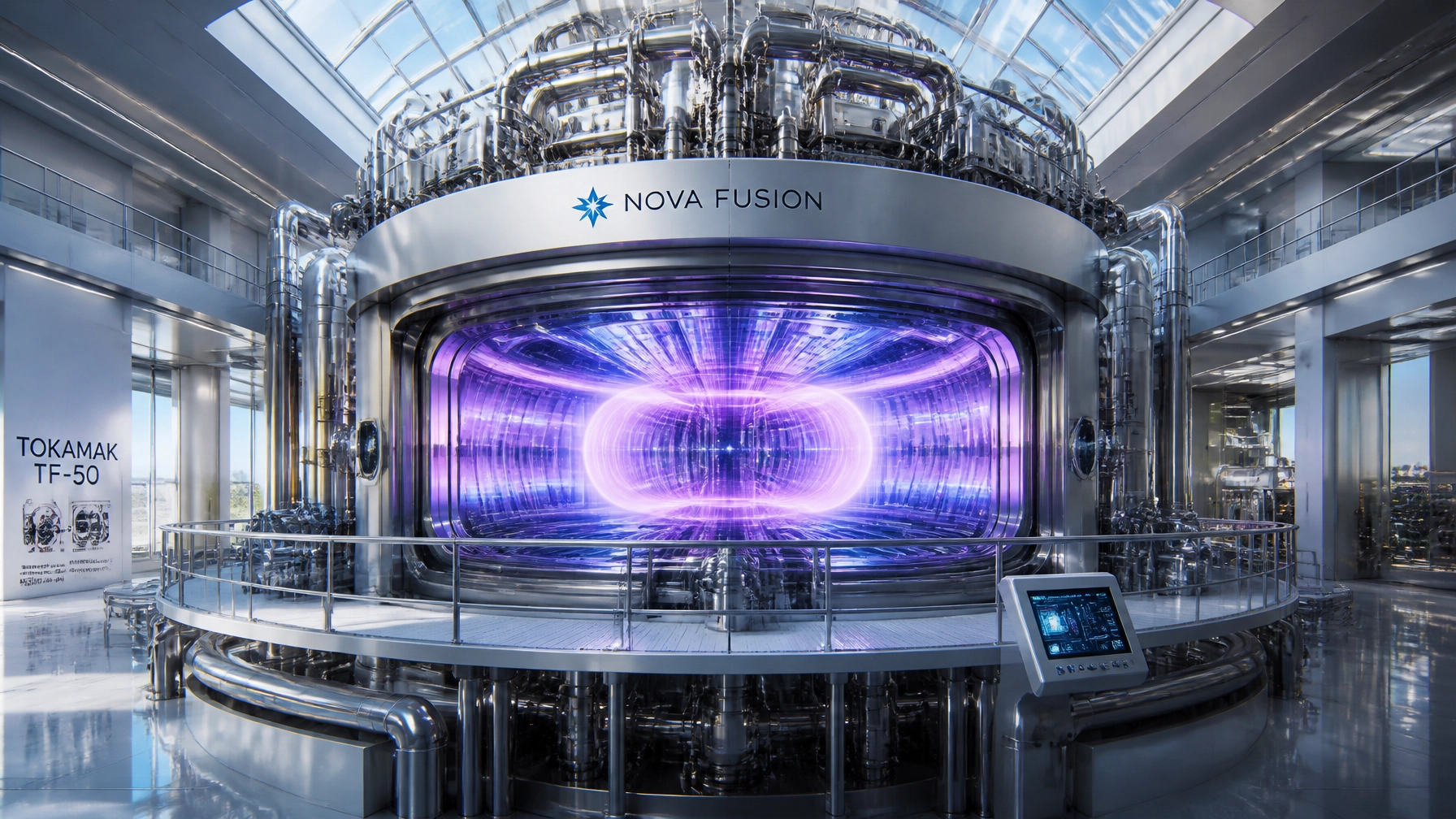
Meta Description: Strategic innovator Robert Kuypers analyzes China’s July 2026 fusion energy milestone, the global race for the "Artificial Sun," and why energy independence is the ultimate fiscal and geopolitical move.
I. The Futurist’s Playbook: Why 2026 is the Year of the Star
I don’t just follow trends: I build the playbook. As a Strategic Innovator and Futurist who has spent over 26 years navigating the complex intersection of technical vision and business execution, I’ve learned to spot the "shortest path" to global transformation. Today, that path isn't paved with software alone; it’s being forged in the heart of plasma at 100 million degrees Celsius.
This morning, the news hit the wires: China’s “Artificial Sun” (the EAST project) just cleared a massive engineering hurdle in late June and early July 2026. They’ve successfully tested and accepted two domestically developed superconducting magnet systems. This isn’t just a lab win; it’s a full-scale demonstration that they have localized 100% of the core technology needed to harness the power of the stars.
As someone who bridges the gap between engineering teams and C-level leadership, I see this as the ultimate "career DNA" for humanity. We are talking about a total pivot in the global energy hierarchy. If you aren't paying attention to fusion in 2026, you aren't looking at the board.

II. Fiscally Conservative, Globally Disruptive
Let’s talk money, because as a fiscally conservative strategist, I’m always looking at the ROI of progress. Fusion has been “thirty years away” for about fifty years. But in 2026, the math has changed. The per-meter cost of superconducting materials in China has plummeted from 400 yuan to roughly 100 yuan. That is a 75% cost reduction in the raw material of the future.
When costs drop like that, the "shortest path" to commercialization becomes a sprint. While international projects like ITER in France are targeting the mid-2030s for full operation, private players like Commonwealth Fusion Systems and national efforts in the East are aiming for grid-connected electricity by 2030.
I’ve always said that I strive to leverage cutting-edge technology to drive brand strength and profitability. In the macro sense, "Brand Earth" is currently bleeding capital on inefficient, carbon-heavy, and geopolitically toxic energy sources. Fusion is the pivot. It’s the ultimate growth model for a planet that needs unlimited, clean, baseload power to sustain its next century of innovation.
III. The Geopolitics of Self-Defense and Energy Independence
You cannot separate technology from the world stage. As someone who is staunchly anti-war but pro-self-defense, and a vocal supporter of a free Ukraine and a liberated Venezuela, I see fusion as the ultimate weapon of peace.
Why are we still beholden to authoritarian regimes that use natural gas as a leash? Why is the world's economy vulnerable to the whims of a regime in Moscow that would rather see cities burn than democracy flourish?
Energy independence is the most powerful form of self-defense. By accelerating fusion, we aren't just building a reactor; we are dismantling the leverage of every petro-dictator on the planet. I don’t just support technology because it’s "cool": I support it because it has the power to amplify human freedom and forge a world where we no longer fund our enemies every time we turn on the lights. Supporting Ukraine means more than just sending hardware; it means building a future where their energy: and ours: can never be switched off from the outside.

IV. The Kuypers Perspective: Legacy and The Next Generation
I’m a dad. When I look at the skyline with my kids, Kenley and Braden, I’m not just seeing steel and glass. I’m seeing the world they will inherit. Whether we are checking out the view from an observation deck in NYC or I’m building apps to make their lives (and mine) a little more organized, my "why" is always the same: creating a sustainable legacy.
Fusion matters in 2026 because we are finally at the point where the engineering is meeting the vision. China’s recent success with their toroidal-field superconducting magnets and their high-temperature central solenoid coil: increasing the weight from 350 to 580 tons: shows that we are moving from "maybe" to "when."
I’ve spent my career as a self-proclaimed tech guru and strategist, and I can tell you that the transition from scientific theory to heavy engineering is where the real value is created. We are in the "heavy engineering" phase of fusion. It’s messy, it’s expensive, and it’s absolutely necessary.

V. Not Just a Lab Experiment: It’s a Manifesto for Growth
I don't just follow the science; I analyze the momentum. Not just the "what," but the "how fast." Here is how I see the 2026 fusion landscape:
- The Localization Lead: China has reached 100% domestic localization for their magnet tech. In business terms, they’ve verticalized their supply chain. That’s a move I respect. It removes external dependencies.
- The Private Sector Sprint: Companies like Helion and Commonwealth Fusion Systems are filing for grid interconnections. They aren't asking for permission to exist; they are asking for a place to plug in.
- The Strategic Pivot: We are moving away from the "Greenwald limit" and toward stable, long-pulse operation. Keeping plasma at 100 million degrees for over 17 minutes (as the EAST project did previously) is the difference between a sparkler and a furnace.
I’m a tech-marketing hybrid. I know how to sell a vision, but I also know how to read a schematic. When I see these milestones, I see the "shortest path" to a post-scarcity energy economy. This isn't just about electricity; it's about the ability to desalinate water, produce green hydrogen at scale, and power the massive compute loads of the future without melting the ice caps.
VI. The Bridge Between Technical Vision and Execution
As an expert in strategic consulting and app development, I often tell my clients that you can’t manage what you don’t understand. The leadership of the future needs to understand the physics of their industry.
The "Artificial Sun" milestones in 2026 are a wake-up call. We are seeing a global race that looks a lot like the Space Race of the 1960s, but with much higher stakes. The winner doesn't just get a flag on the moon; they get the keys to the global economy for the next three centuries.
I strive to accelerate the conversation around these technologies because they are the foundation of everything else we build. Whether I'm growth modeling for a tech startup or advising a legacy firm on digital transformation, the underlying cost and availability of energy is the "alpha" variable in every equation.

VII. Closing the Gap: A Call for Strategic Collaboration
Does fusion energy really matter in 2026? It matters more than almost anything else on the horizon. It is the intersection of fiscal responsibility, social liberalism, and humanitarian compassion. It is the technology that will finally allow us to stop fighting over what’s under the ground and start looking at what we can create together.
I’m an optimist by trade and a strategist by necessity. I believe that by bridging the gap between technical vision and business execution, we can transform the world into something better for Kenley, Braden, and every kid growing up in a world currently shadowed by energy-driven conflict.
The milestone in China is a reminder that the world isn't waiting. We need to leverage every ounce of our own innovation, amplify our investments in domestic fusion, and forge ahead with the confidence that the star-power we seek is finally within our grasp.
Let’s build the future. Not just because we can, but because we must.
Forward, always.
( Robert Kuypers)