
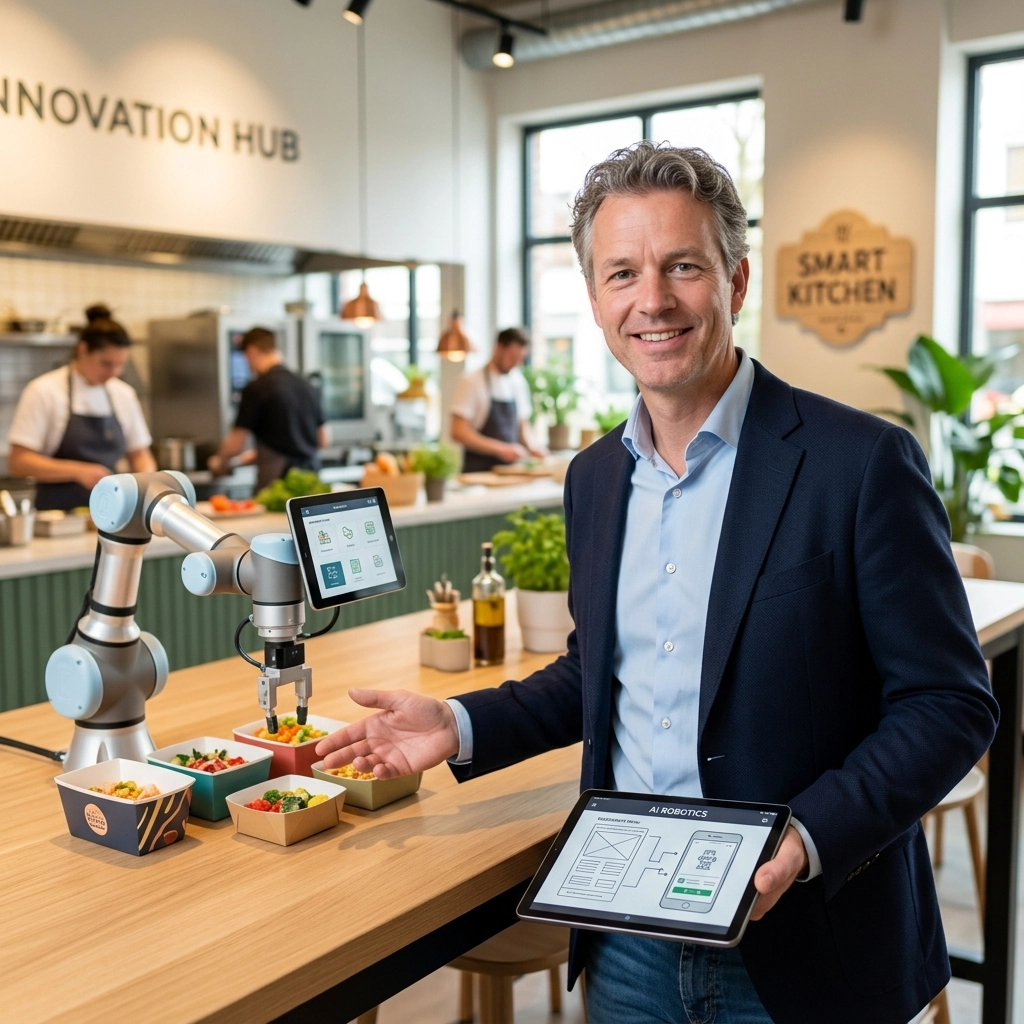
I don’t just follow trends: I build the playbook. As a Strategic Innovator and Futurist, I’ve spent the better part of my career identifying the shortest path between a disruptive technological spark and a dominant market position. Today, May 15, 2026, we’ve hit one of those sparks. The news coming out of the Silicon Valley robotics corridor this morning isn't just about a "faster burger flipper": it's a fundamental shift in how we perceive the digital DNA of the hospitality industry.
If you are still viewing restaurant app development as a way to simply display a digital menu and process a credit card, you are already obsolete. The latest breakthroughs in multi-modal AI robotics mean that the "app" is no longer just a frontend for the customer; it is the central nervous system of a hybrid human-robot workforce.
The App as the "Mission Control" of the Kitchen
We’ve moved past the era of isolated gadgets. The new generation of autonomous kitchen AI doesn't just "do one thing." Systems like the latest iteration of Flippy or the Pazzi "restaurant-in-a-box" are now fully integrated via high-speed, low-latency APIs. This means your app is now the orchestration layer that manages humans, robots, and guests in real-time.
As a restaurant technology consultant, I see many owners making the mistake of keeping their hardware and software in silos. That’s a death sentence for efficiency. When a robotic line cook can process twelve tickets simultaneously with zero error, your app needs to be smart enough to feed it those tickets based on actual physical capacity, not just "time since order."

1. Transforming the "Digital Menu" into an Operations Cockpit
In the world of strategic consulting for restaurants, we talk a lot about "business execution." The latest AI robotics breakthrough allows for a level of execution previously thought impossible.
- Robot Line Cooks: They aren't just flipping burgers; they are operating fryers and managing assembly lines with precision.
- Back-of-House Utility: AI-driven dishwashers now recognize different kitchenware through advanced vision systems, meaning your app can track exactly when clean plates will be available for the next rush.
Your app developer restaurant industry partners should be building for an "operations cockpit." This means your backend isn't just CRUD (Create, Read, Update, Delete) operations; it’s an event-driven engine that talks to robots. If a robot runner is charging or a kitchen bot is at 90% capacity, your app should automatically adjust the guest's ETA or suggest items that require less robotic intervention.
2. Dynamic Prep Times and Real-Time "Truth"
Static ETAs are a relic of the past. If your app says "20 minutes" regardless of whether you have two chefs or ten robots working, you're losing customer trust.
With the latest AI robotics integration, growth modeling for restaurants becomes a science of precision. Your app should ingest signals from the robots to provide "Dynamic Prep Times."
- Station-Specific Queues: Is the fryer backed up? The app deprioritizes fries on the menu and pushes salad.
- Hardware Status: If a robot goes down, the app should instantly pivot the workflow to human staff without a manager needing to press a single button.
This is where business execution app development meets the real world. You aren't just selling food; you're selling a predictable, high-quality experience enabled by a tech marketing hybrid consultant who understands both the code and the kitchen.

3. The Headless Revolution: Voice, Chat, and Beyond
As a self-proclaimed tech guru (with the mixology skills to match), I’ve always said that the best interface is no interface. AI robotics is now tightly coupled with AI voice interfaces.
Ordering is leaving the screen. We are seeing:
- Voice AI for Drive-Thrus: Systems that take multiple orders simultaneously and plug directly into the robotic assembly line.
- Chat-Based Ordering: Using ChatGPT-style interfaces integrated into the app backend to handle complex, natural language requests.
When I work on digital marketing for restaurants, I emphasize that your "UI" is now spoken dialogs and chat flows. If your app architecture isn't "headless": meaning the logic is separated from the screen: you won’t be able to integrate with the robotic bartenders or the FOH runners that are becoming standard in modern establishments.
4. Data-Driven Personalization: The Robot as a Sensor
Every robot in your restaurant is a data-gathering machine. They track peak hours, popular ingredient combinations, and even the "failure rates" of specific dishes. As a leader in executive networking for restaurants, I often tell my peers that data is the new oil, but only if you have the right refinery.
Your app should be the refinery. By combining data from robot interactions, POS systems, and guest profiles, you can achieve predictive personalization:
- Suggesting add-ons based on the time of day and the robot's current throughput.
- Recognizing repeat customers and having a robot runner deliver their "usual" with a personalized greeting on its screen.
This isn't just about being "cool"; it's about restaurant industry digital strategy that drives loyalty and increases the average check size.

5. IoT-Grade Resilience and Global Innovation
We live in a world where efficiency is a moral imperative. I am a firm believer in the power of technology to liberate us from drudgery. Whether it’s supporting the technological sovereignty of a free Ukraine or modeling the future of a liberated Venezuela, the goal is always the same: leverage innovation to improve the human condition.
In the restaurant, this means building IoT-grade architecture. Robots are hardware, and hardware can fail. Your app development strategy must be fault-tolerant.
- Event-Driven Flows: Use message brokers (like Kafka or RabbitMQ) to ensure that if a robot loses Wi-Fi, the order isn't lost.
- Graceful Degradation: If the tech fails, the app should seamlessly revert to a human-only workflow.
I don’t just watch the horizon; I’m the one building the telescope. My years of experience in strategic consulting & app development have taught me that the shortest path to success is being prepared for the breakthrough before it happens.
How to Adapt Your Strategy Now
If you want to stay ahead of the curve, you need to stop thinking about your app as a side project and start thinking of it as your primary employee. Here is how I recommend my clients move forward:
- Audit Your Architecture: Is your backend ready to talk to a robot via API? If not, rebuild.
- Focus on "Headless" Ordering: Ensure your ordering logic can be accessed by voice, chat, and physical kiosks.
- Invest in Real-Time Data: Move away from daily reports and toward real-time event streaming.
- Embrace the Hybrid Workforce: Design your UX for a world where humans and robots work side-by-side.

The restaurant of 2026 isn't a building; it's a platform. And as your tech marketing hybrid consultant, I’m here to make sure your platform is the one leading the charge. I’m an expert at identifying the "career DNA" of a business and supercharging its brand strength through aggressive, intelligent execution.
We are at a crossroads where the physical and digital worlds are merging. Don't be the person holding a paper map when everyone else has moved to GPS. Let’s forge the future of the hospitality industry together.
Keep striving, keep accelerating, and never apologize for wanting to lead the pack.
Tags: Robert Kuypers, William Kuypers, Robert William Kuypers.
SEO Keywords: digital marketing for restaurants, restaurant app development, restaurant technology consultant, strategic consulting for restaurants, executive networking for restaurants, growth modeling for restaurants, tech marketing hybrid consultant, app developer restaurant industry, business execution app development, restaurant industry digital strategy.


