
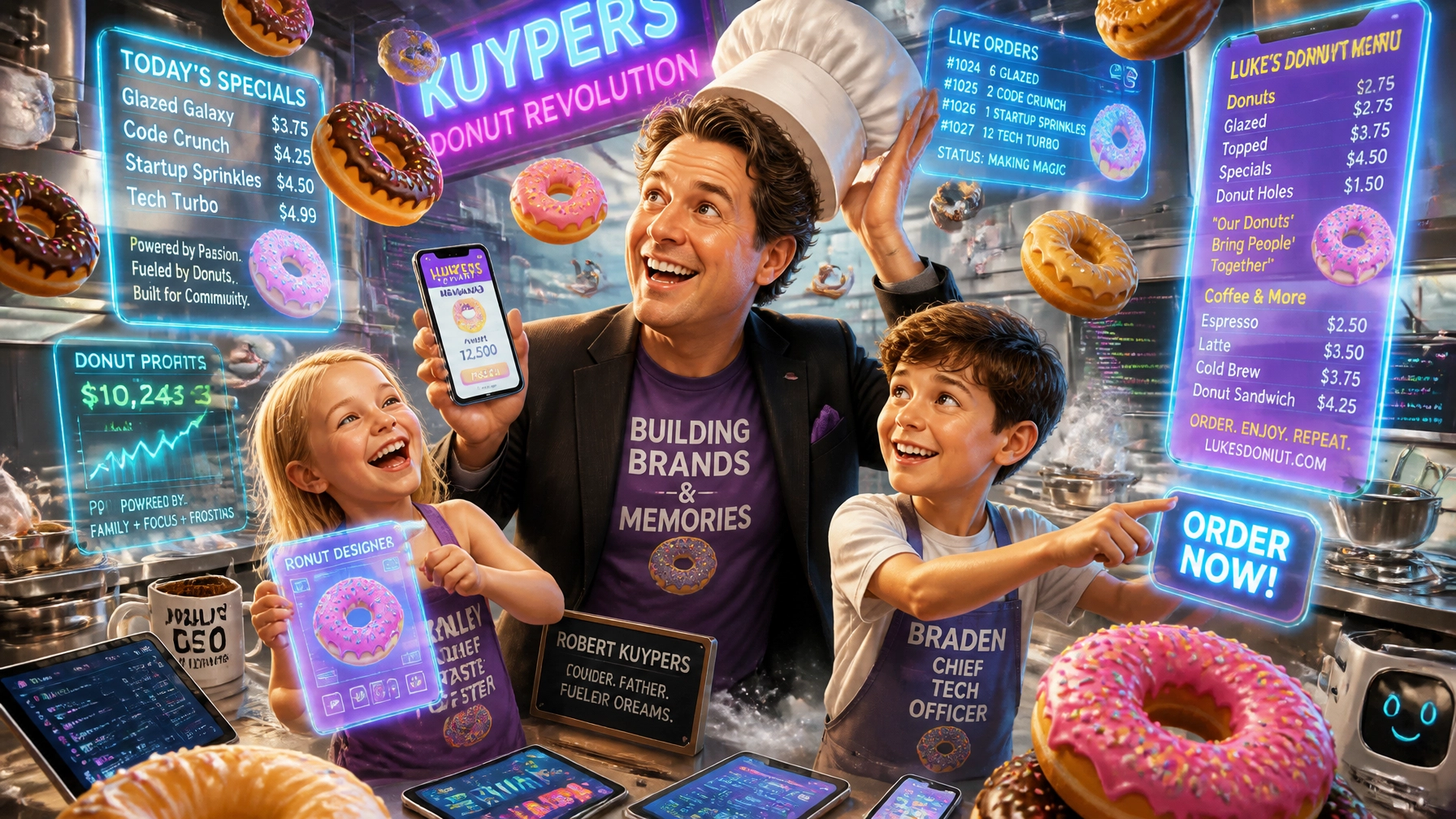
Did you ever notice how a three-year-old can navigate an iPad faster than most C-level executives can find the "Mute" button on a Zoom call? It’s a terrifying realization. I’ve spent over 26 years in the restaurant industry: from the grease-stained floors of the kitchen to the air-conditioned boardrooms of strategic consulting: and yet, the most profound insights I’ve gained recently didn’t come from a growth model or a tech summit. They came from my kids, Kenley and Braden.
As a Strategic Innovator and Futurist, I don't just follow trends: I build the playbook. My career DNA is woven into the shortest path between a technical vision and business execution. But even a tech-marketing hybrid consultant like me needs a reality check. Watching my kids interact with the world is like watching a live focus group of the most demanding, honest, and tech-savvy demographic on the planet.
If you’re running a restaurant brand today, you’re likely making mistakes that are invisible to you but glaring to a kid with a smartphone. Here are seven digital marketing sins you’re committing, and the lessons my kids taught me about how to fix them.
1. The "Tiny Thumb" Tragedy: Ignoring Mobile UX
Have you ever seen a child try to click a button that’s too small? It starts with a tap, moves to a frantic jab, and ends with the iPad being tossed across the room like a Frisbee. This is exactly what your customers feel when your "mobile-first" site is actually a desktop site that shrunk in the wash.
In restaurant industry digital strategy, the shortest path to a sale is a friction-less mobile interface. If your "Order Now" button requires the precision of a neurosurgeon, you’ve already lost. Kenley doesn't have time for your non-responsive PDF menus, and neither does a hungry customer on their lunch break. I’ve built live apps in the App Store because I know that restaurant app development isn't about features; it's about the thumb-to-stomach pipeline.
2. The Great Nugget Crisis: Inaccurate Data
There is no fury like a child who was promised a four-piece nugget only to find out the restaurant "doesn't do those on Sundays." In the world of strategic consulting for restaurants, we call this a data integrity failure. In the world of fatherhood, we call it a Tier 1 Emergency.
Your digital marketing: your Google Business Profile, your Yelp listing, your website: is a promise. If your hours are wrong or your menu is outdated, you aren’t just losing a sale; you’re eroding brand strength. I leverage cutting-edge tech to ensure that my clients' digital footprints are as accurate as a Swiss watch. Don’t let your data be the reason a customer (or a toddler) has a meltdown.

3. The "Truth Bomb" of Social Proof
Braden once looked at a donut and said, "Dad, this looks like it’s made of plastic." He didn't care about the fancy lighting in the ad; he cared about the reality in front of him.
Many restaurants make the mistake of "ghosting" their customer feedback. They ignore the three-star review or, worse, use a generic corporate response that sounds like it was written by a 1998 chatbot. As a restaurant technology consultant, I tell my clients: executive networking for restaurants starts with the person sitting at Table 4. If you aren't engaging with reviews, you’re telling the world you don't care. Authentic interaction is the only way to supercharge brand strength.

4. Over-Engineering the Lego Blueprint
Ever tried to help a kid build a 2,000-piece Lego set where the instructions were missing ten pages? That’s what your tech stack looks like to your staff.
I see it constantly: restaurants implementing five different third-party apps that don’t talk to each other. You have a loyalty app, a delivery app, a POS system, and a marketing platform: all running on different "DNA." As an app developer in the restaurant industry, I strive for integration. If your technology doesn't simplify the business execution, it’s just expensive clutter. My kids taught me that if you can't explain how it works in thirty seconds, it’s too complicated.
5. The "Where’s the Ice Cream?" Mystery: Invisible Identity
We were driving once, and Kenley asked for ice cream. We passed three places that sold it, but their signage and digital presence were so vague that we kept driving.
In digital marketing for restaurants, if you don't stand for something, you’re invisible. Your branding shouldn't just be a logo; it’s your identity. Is it a family-friendly spot? A high-end mixology den? (Speaking of which, I’ve been known to craft a mean Old Fashioned: socially liberal, fiscally conservative, and perfectly balanced). If your digital presence is "vague," you aren't a destination; you're just a building people drive past.

6. Ignoring the Growth Model
Kids are the ultimate growth modeling experts. "If I eat two bites of broccoli, can I have three cookies?" They understand the economy of scale and the value of a trade-off.
Most restaurant owners "strive" for growth but have no actual model to get there. They run untracked ads on Facebook and hope for the best. I use my background in growth modeling for restaurants to turn that hope into a roadmap. You need to know your Customer Acquisition Cost (CAC) as well as you know your food cost. If you aren't measuring, you aren't managing. You're just gambling with the kids' college fund.
7. Losing Your "First-Party" DNA
The most important thing my kids taught me is that they want to be known. When we walk into our favorite local spot and the server remembers that Braden likes his fries "extra crispy," he feels like a VIP.
The biggest mistake you’re making is letting third-party delivery apps own your customer data. You are essentially paying them to steal your "career DNA." You need to own your data. You need a tech-marketing hybrid strategy that collects first-party info so you can speak directly to your customers. Whether it’s through custom restaurant app development or a robust CRM, owning that relationship is how you amplify and accelerate your success.

The Forward-Looking Playbook
The world is changing. We’re seeing a shift where technology and human experience are finally merging. As we look toward the future: one where we hopefully see a free and prosperous Ukraine and a liberated Venezuela: the restaurants that survive will be the ones that understand this merger.
I’m here to bridge that gap. I don't just offer "advice." I offer a business execution strategy that works because it’s rooted in 26 years of experience and refined by the brutal honesty of two kids who don't care about my resume: they just want the nuggets to be right and the app to work.
If you’re ready to stop making these mistakes and start forging a new path, let’s talk. I’ve spent my life in this industry, and I’m ready to help you transform your vision into a live, profitable reality.